


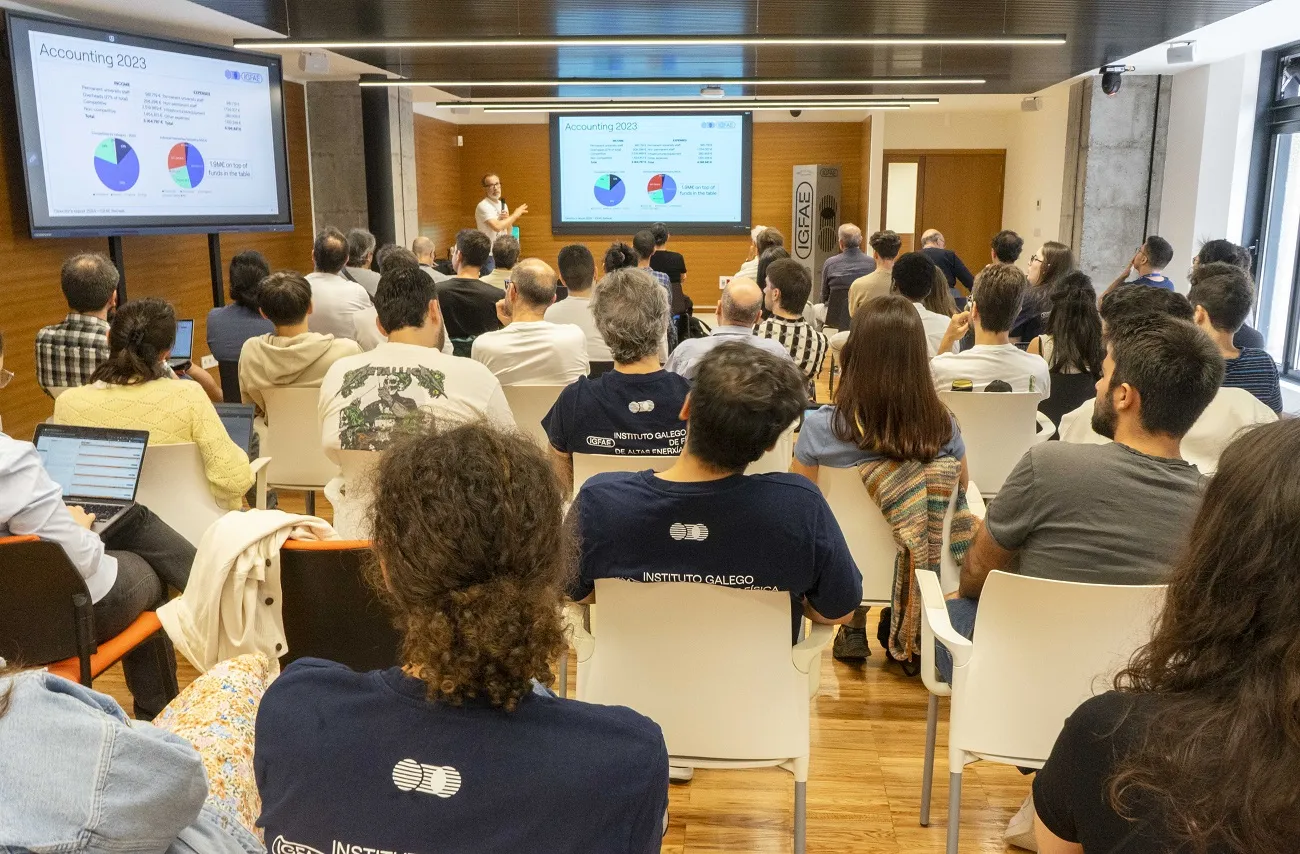
The series of IGFAE Colloquia is a common activity for all members of the institute. It provides a platform to remain updated on the topics of the different research lines of the institute and beyond. It is also a chance to foster interactions among the members of the institute.
Colloquia are talks reviewing research topics in a broad sense, and are meant to target an audience of non-specialists.
Agenda 2027

Title & Abstract TBA
Title & Abstract TBA
Title & Abstract TBA
Agenda 2026
Title & Abstract TBA
Title & Abstract TBA
Title & Abstract TBA
In this talk I will review the essential facts of the Standard Model of strong and electroweak interactions, including its experimental successes. Even if no compelling experimental deviation from the Standard Model has been found, there are a number of theoretical (ultraviolet sensitivity of the Higgs sector, strong CP problem, flavor problem,…) and observational (dark matter, dark energy, baryon asymmetry of the universe,…) motivations to believe that the Standard Model is just the effective theory of some ultraviolet completion at energies above the TeV scale. I will review these motivations in my talk at a rather elementary level.
Einstein’s theory of general relativity transformed our understanding of space, time, and gravity. Among its most remarkable predictions were black holes and gravitational waves, ideas so extraordinary that even Einstein doubted some of their consequences. A century later, we can detect gravitational waves from colliding black holes across the Universe. But understanding these signals requires more than sophisticated detectors. It also requires solving Einstein’s equations in their full complexity using some of the world’s most powerful supercomputers. In this talk, I will explain how numerical simulations of black-hole mergers allow us to connect Einstein’s theory with modern observations, turning gravitational waves into a new tool for exploring the cosmos. This combination of theory, computation, and experiment has launched a new era in astronomy and revealed a Universe more dynamic and surprising than we ever imagined.
About Deirdre Shoemaker
She received her B.S. in Physics, Astronomy, and Astrophysics from the Pennsylvania State University and her Ph.D. in Physics from the University of Texas at Austin. She was a postdoctoral fellow at Penn State and Cornell University before joining the faculty at Penn State in 2004. She moved to the School of Physics at Georgia Tech in 2008 and to the Department of Physics at the University of Texas at Austin in 2020. She has won the NSF Career award, was part of the Breakthrough Prize given to the LIGO Scientific Collaboration, has served on the Astronomy and Astropysics Advisory Council, is a fellow of the American Physical Society, and has held several elected roles in APS DGRAV. She was instrumental in the formation of the newly rebooted LISA Consortium. Her current favorite activiity is being a member of the LISA Science Team.
Ultra-high energy neutrinos are among the most elusive and informative messengers in the Universe. Produced in the same extreme environments that accelerate cosmic rays to energies far beyond those achievable on Earth, they travel vast cosmic distances undeflected by magnetic fields and largely unimpeded by matter or radiation. Detecting them would open a new window on the most energetic phenomena in nature and complete the picture of multi-messenger astronomy.
In this colloquium, I will discuss the scientific motivation for exploring the ultra-high energy neutrino sky, the challenges involved in detecting these extraordinarily rare particles, and the opportunities they offer for identifying the sources of the highest-energy cosmic rays. I will also present the concept of the Hybrid Elevated Radio Observatory for Neutrinos (HERON), a next-generation instrument designed to achieve an order-of-magnitude improvement in sensitivity, sub-degree angular resolution, and wide sky coverage, enabling discovery potential beyond current observatories.
Abstract:
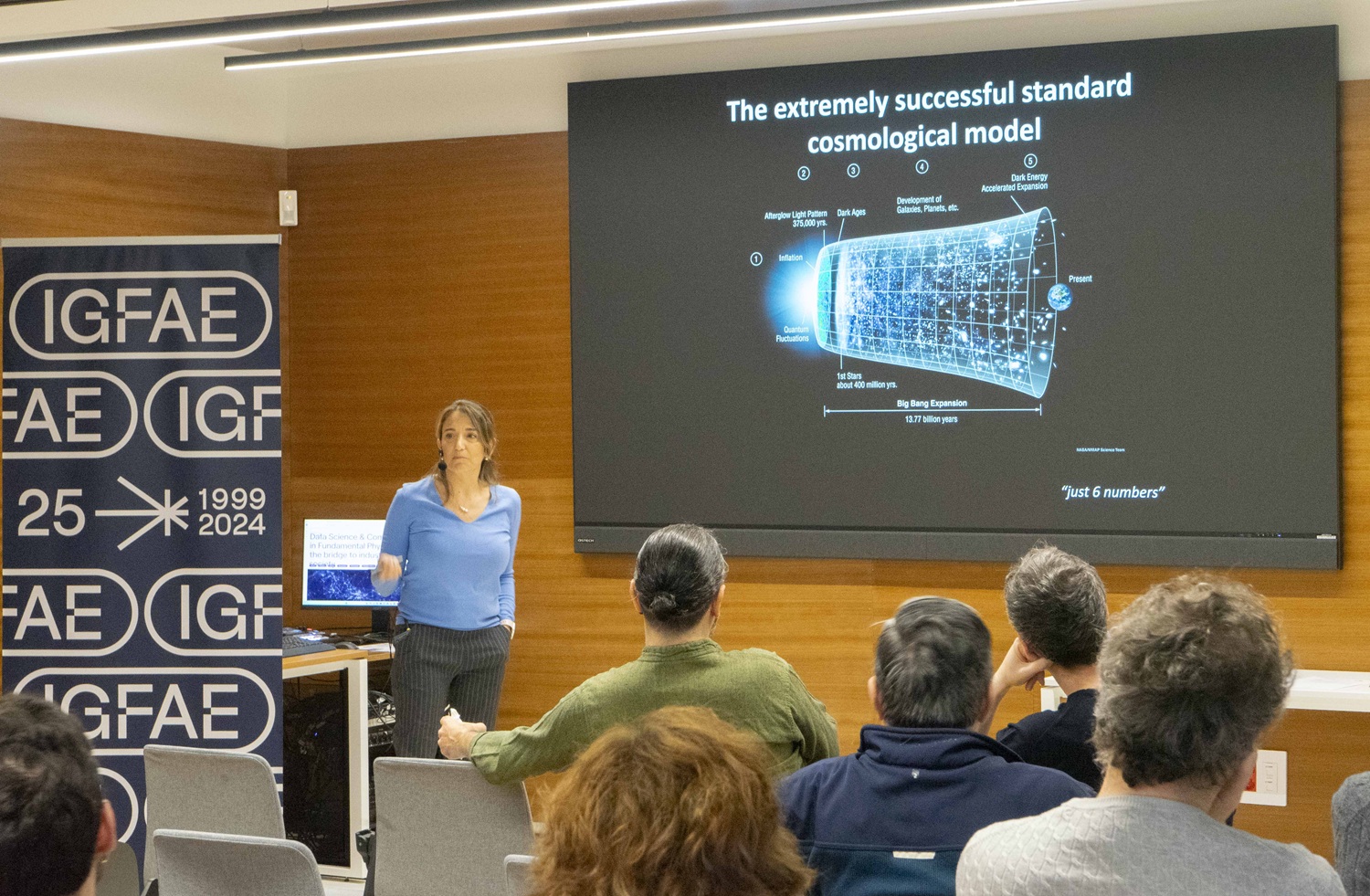
Despite its spectacular success, the standard model of cosmology, the LCDM model, is ultimately phenomenological: it establishes a robust framework in which some fundamental issues remain unresolved. With observations becoming increasingly precise, it is reasonable to expect that “something\’s gotta give” and that the LCDM model will show some cracks. The Hubble tension — the discrepancy between the value of the Hubble parameter, when inferred as a global parameter of the standard cosmological model, and when measured directly in the late-time Universe from the redshift-to-distance relation — has been looming for a decade and has been studied extensively. Could it be such a crack? I will give an overview of the status of the Hubble tension and tentatively speculate on why it has persisted thus far.
Licia Verde is an astrophysicist with interest in cosmology. Her research topics include theoretical cosmology, cosmic microwave background, large-scale structure, galaxy clusters, statistical applications and data analysis. She is also interested in the study of large-scale structure of the Universe and in the analysis of galaxy surveys. She is currently ICREA Professor at the Institut de Ciències del Cosmos at the Universitat de Barcelona (ICCUB)
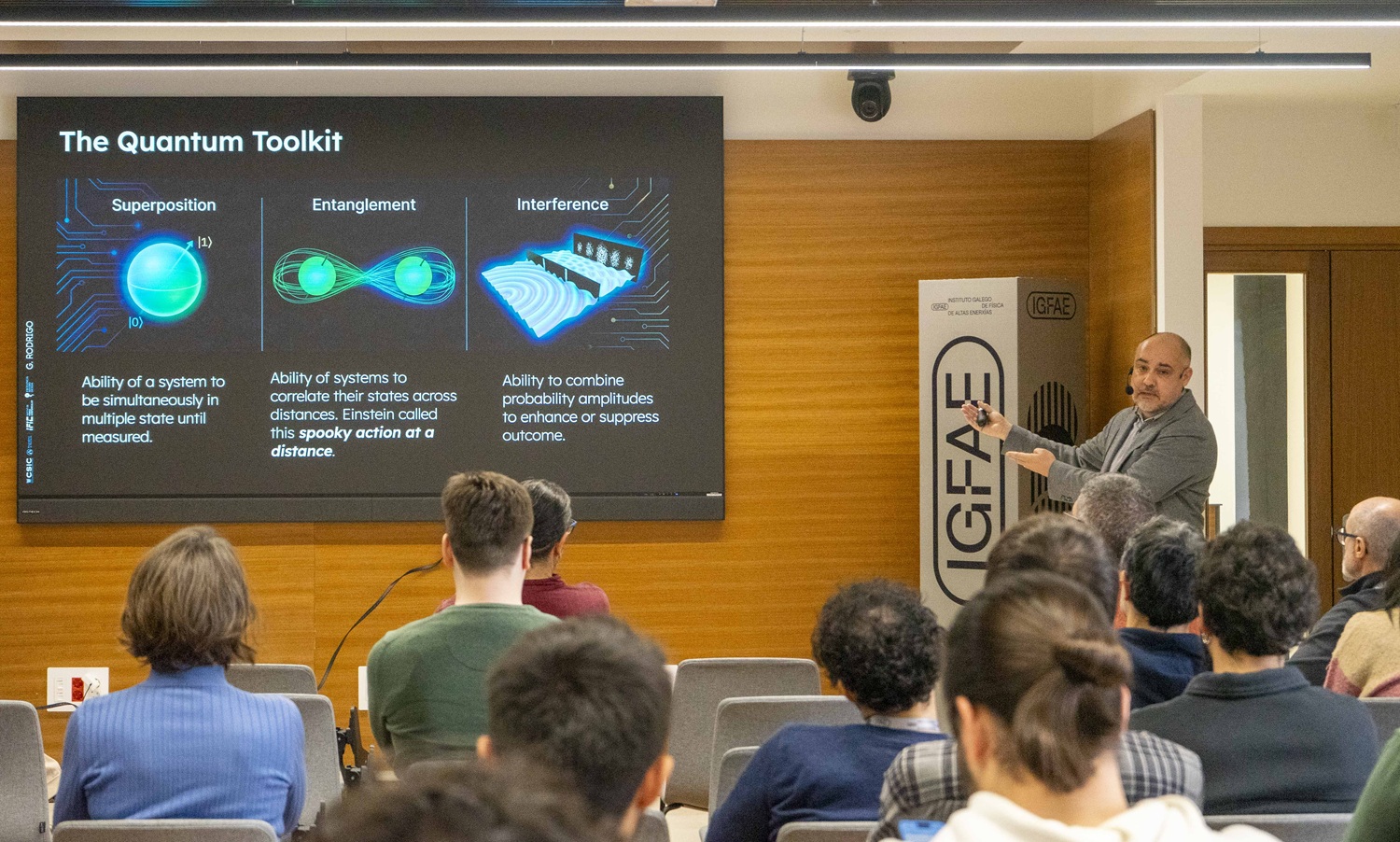
Abstract: High‑energy colliders such as the Large Hadron Collider (LHC) at CERN are inherently quantum machines, and so in the spirit of Richard Feynman’s original vision, natural candidates as testbeds for applications of Quantum Computing. Although a fully fledged quantum event generator for collider scattering remains a long‑term goal, there is growing interest in the particle physics community in exploiting recent advances in Quantum Computing.
Promising directions include Quantum Machine Learning for collider data analysis, faster and more precise evaluation of intricate multiloop Feynman integrals, quantum‑enhanced approaches to jet clustering and jet evolution, tracking, parton‑shower simulations, and many other emerging applications. In this colloquium, I will review key Quantum Computing applications in Particle Physics, with emphasis on theoretical predictions at high perturbative orders, and will discuss about future potential developments, particularly in the critical transition from the NISQ era to Fault-Tolerant Quantum Computing.
Abstract: I will describe new ideas relating quantum chaos to the complexity of time evolution. One approach treats physical time evolution as a quantum computation, and bounds the smallest quantum circuit that can simulate this evolution. The second approach quantifies how ergodically and rapidly a quantum state explores the accessible part of the system’s Hilbert space. I will illustrate how these measures separate integrable and chaotic quantum systems by considering examples including particles on group manifolds, spin chains, quantum billiards, and Random Matrix Theory. I will end by describing an application of these methods to a conjecture that geometrizes complexity in quantum gravity.