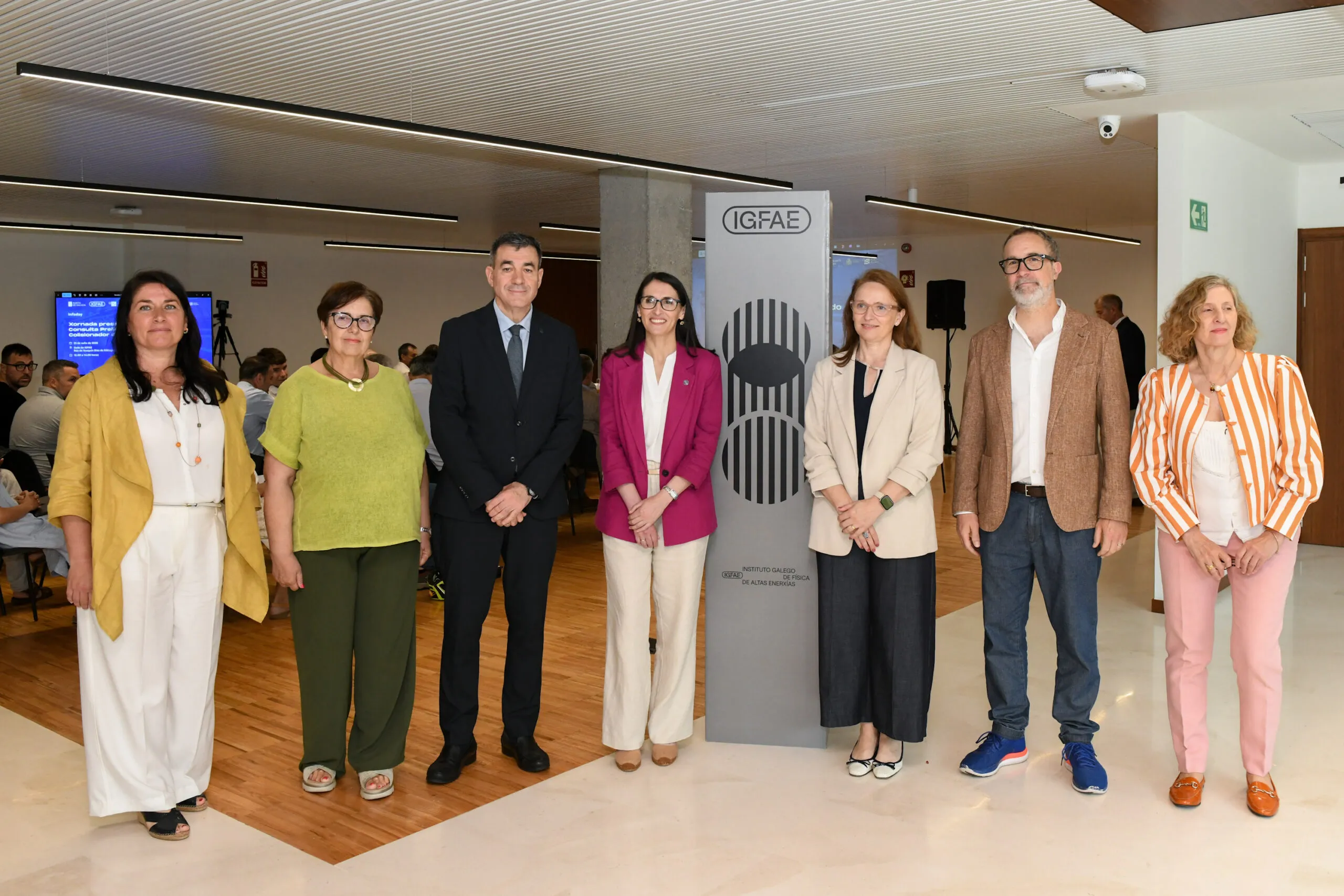
IGFAE headquarters were the venue this Tuesday, June 23rd for the presentation day of the Preliminary Market Consultation on the construction of a prototype for CERN’s Future Circular Collider (FCC), one of the most significant scientific and technological challenges of the coming decades.
More than 130 companies and R&D&I stakeholders participated in the event, held both in person and online, where the scientific and technological foundations of the project were presented, along with the market consultation and the upcoming tender for the pre-commercial public procurement, funded by Feder Funds.
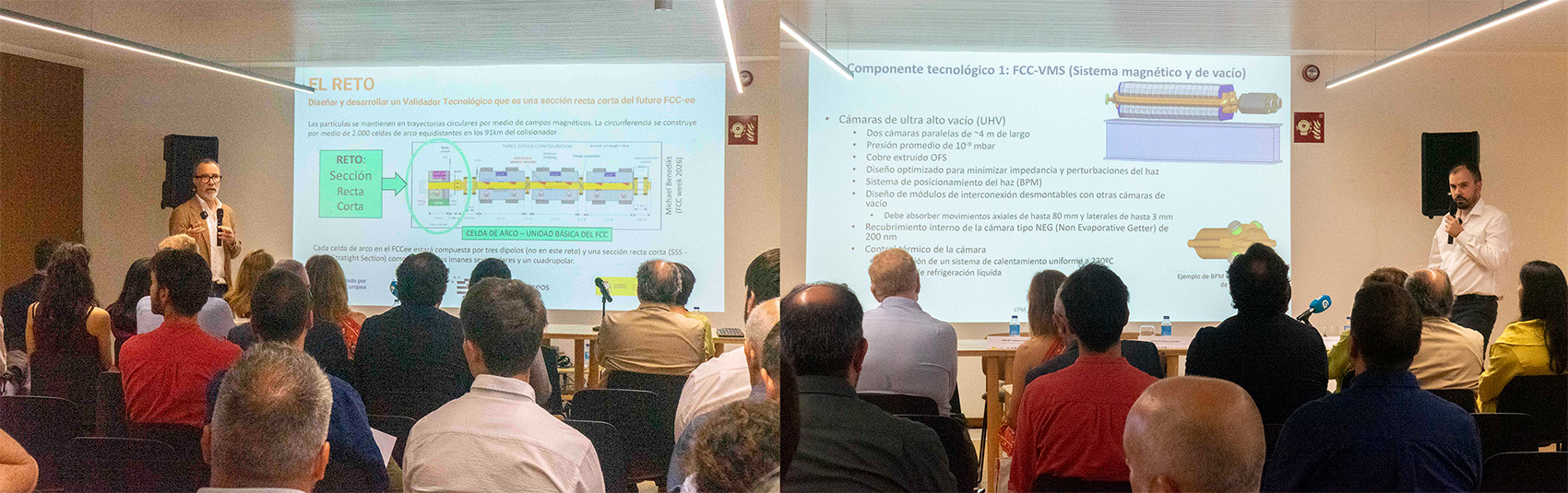
During the event, the technological challenge posed by the construction of this prototype was presented by Carlos Salgado, director of IGFAE, and Antonio Fernández Prieto, electronic engineer at the Institute. From the administrative perspective, Soledad Ilarduya, coordinator of this FCC challenge at the Centre for the Development of Technology and Innovation (CDTI), an entity of the Spanish Ministry of Science and Innovation promoting the initiative, also spoke.
{%CAPTION%}
The presentation included the participation of the USC rector, Rosa Crujeiras; the regional minister of Education, Science, Vocational Training and Universities, Román Rodríguez; and the director of Certification and Innovative Public Procurement at CDTI, María Vega Gil Díaz.
Rosa Crujeiras highlighted: “As a university, we are an active agent in knowledge transfer and in building responses to major collective challenges. Our mission is to generate excellent knowledge, train future generations, and contribute to social, economic, and technical progress, and this challenge is a great example of that.”
Román Rodríguez stated: “It is a source of pride that Galicia can be present in this global challenge,” which means “going a bit further: not only developing a prototype, but doing new physics”.
From the Centre for the Development of Technology and Innovation (CDTI), the director of Certification and Innovative Public Procurement, María Vega Gil Díaz, said: “It is a pleasure to see the interest and expectations that this initiative is generating.” Also participating from this public entity, under the Ministry of Science and Innovation, were Ana Isabel Rodríguez, head of the Innovative Public Procurement Office, and Eduardo Serrano, legal officer of the same department.
Preliminary Market Consultation
With the aim of building this prototype in Galicia, the preliminary market consultation is open for companies interested in its manufacture to express their interest until July 9. The construction of the prototype will involve both academia and the industrial sector specialized in particle accelerators. Given the magnitude of the project and its scientific, technical, and financial complexity, close collaboration at all levels is required.
Through this consultation, the goal is to assess the development level of innovative and relevant technologies in the field of particle colliders to carry out the complete prototyping and pre-industrialization of a representative section of the Future Circular Collider (FCC). This consultation marks the beginning of the innovative public procurement process in the pre-commercial contracting modality carried out by CDTI, aimed at enabling the participation of companies and other R&D&I ecosystem stakeholders in this challenge.
In this process, CDTI leads the preliminary market consultation and the Pre-commercial Public Procurement; the Xunta, through the Galician Innovation Agency, acts as the public buyer; and IGFAE, as the scientific and technical promoter, is the knowledge center that defines, monitors, and validates the prototype.
A prototype for a 43-meter long ‘mock-up’
In order to design and test all the components of the first phase of the future FCC, the construction of a 43-meter-long mock-up is planned, in which the prototypes to be developed in the respective countries involved in the project will be assembled. When the FCC is built, this mock-up, conceived as a basic unit called an arc cell, will have to be replicated up to 2,000 times until the entire circumference is completed.
Each of these cells will contain dipole magnets to bend the particle beam, as well as quadrupole and sextupole magnets that focus and defocus this beam. The latter are contained in a subunit called the Short Straight Section (SSS), which is the specific subject of this proposal. For this purpose, a test bench with a full-scale design will be developed, which will be assembled and commissioned at the facilities of the IGFAE itself, and later validated at CERN.