


As part of our commitment to disseminating our research activity to society, every year the IGFAE offers dozens of informative talks for educational centres in Galicia, in which the different disciplines in which we do research at our centre are addressed.
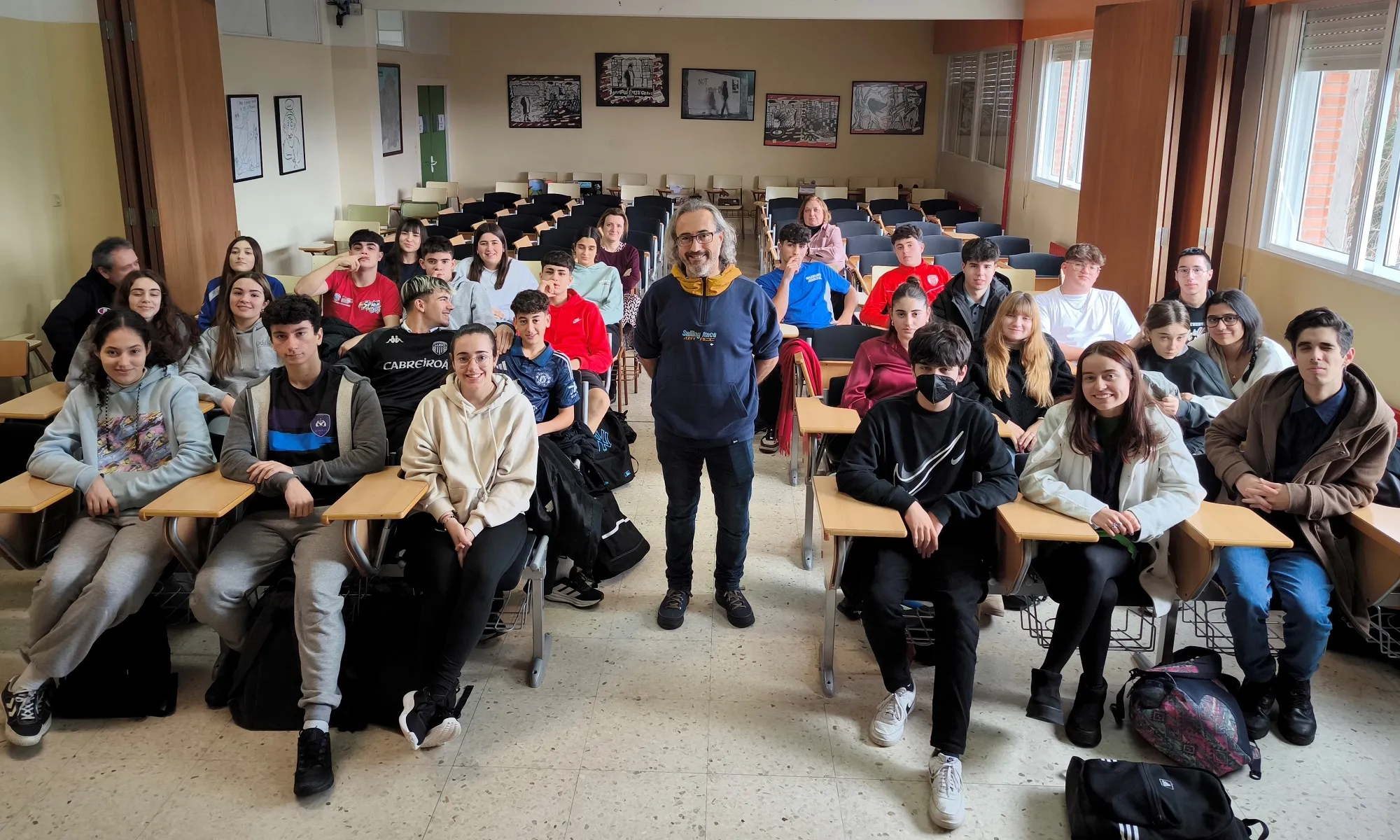
Every year, we reach over 50 schools and more than 1,000 students, who have the opportunity to meet the research staff working on the most cutting-edge physics experiments and international collaborations.
Find below the list of outreach talks for the 2026/2027 academic year:

Do you know how the Universe was born and how the matter that makes up stars, planets and ourselves was formed? How is the mass of elementary particles, essential for the formation of atoms, generated? Have you been told that the matter that makes up us has an almost identical twin, antimatter, which mysteriously disappeared after the Big Bang? Particle Physics seeks answers to questions related to the essential elements that make up the Universe, as well as the forces that govern them. The smaller the object we study, the larger and more complex scientific instruments are needed. The Large Hadron Collider or LHC, the largest and most powerful particle accelerator in the world, is a good example.
The LHC (Large Hadron Collider) is a huge ring with a perimeter of 27 km. It is located 100 meters underground on the border between France and Switzerland, where the CERN (European Organization for Nuclear Research) facilities were built. Here, beams of subatomic particles are collided at speeds very close to that of light. And for what? The goal is to study the result of these collisions and their interactions, to unravel the mysteries of the matter that makes up everything that makes up the Universe. In 2012, the LHC amazed the world with the detection of the Higgs boson. Today, this great experiment continues to study elementary particles. You can discover how it works from the people who work on it.
What are the interactions between the most fundamental elements of everything we know? After an introductory talk on particle physics and the structure of atoms, this activity proposes the construction of nuclei, atoms, molecules and various isotopes using construction pieces of different colors, which represent each elementary particle. This initiative is part of the unique kit “ A materia peza a peza” , a project carried out in collaboration with the Polos Creativos program of the Department of Education of the Xunta de Galicia.
* Activity designed for secondary education students
On August 12, 2026, in the north and east of Galicia, a phenomenon that happens very rarely in life will be observed: a total solar eclipse. And in 2027 and 2028 we will experience two partial eclipses. In addition to the fascinating nature of their observation, these astronomical events had a crucial relevance in the history of physics: in 1919, four years after the publication of Albert Einstein’s theory of general relativity, an eclipse allowed us to confirm what the famous physicist had postulated: light was curved by the influence of the gravity of enormous masses, such as the Sun itself, altering space-time. Come and learn about the science behind the most famous eclipse in history!
Cosmic rays are particles that come from space and constantly bombard the Earth (yes, us too) from all directions. Most of these particles are protons or atomic nuclei, and some of them are more energetic than any other particle observed in nature. These cosmic rays travel at close to the speed of light and have hundreds of millions of times more energy than the particles produced in the most powerful accelerator built by humans, the LHC. The origin of these cosmic rays remains a mystery, as their trajectory is deflected by the magnetic fields of space. How are these cosmic messengers produced?
Marie Sklodowska-Curie is a reference name when we talk about the role of women in the history of Physics. However, the Academy tried to deny her her first Nobel Prize because she was a woman, something that was only prevented by the intervention of her husband Pierre. There are many other figures who made essential contributions to the advancement of this science, despite being hidden for a long time by heteropatriarchal discrimination. The life of Alan Turing, a pioneer of computing, was cut short by the persecution to which he was subjected because of his sexual condition. The essential role of Lise Meitner in the discovery of nuclear fission was undervalued compared to the laurels that Otto Hahn received. In this talk we will talk about the history of these and other figures who, for hundreds of years, have contributed to our better understanding of the Universe, from the most distant galaxies to the most elementary particles. And who, at the same time, opened the doors to a more diverse science.
Dark matter is one of the most important challenges facing physics today. It accounts for 80% of the total matter in the Universe, and the only available evidence of its existence comes from its gravitational interaction on cosmological scales, since it is completely invisible in the entire electromagnetic spectrum. So how do we detect it? For decades, huge experiments have searched for the collision between particles and atoms in inert detector media. On the other hand, powerful satellites have searched for the products of the destruction between particles and antiparticles of dark matter. But there have been no results, for now: no evidence suggests the observation of this elusive matter. New theories support the possibility of observing it indirectly in particle accelerators such as the LHC; there, detectors such as ATLAS or CMS are taking their first steps in their search, and others such as LHCb would be particularly suitable for their search in specific theoretical contexts. Therefore, particle physics could have the last word as far as its existence is concerned.
The Chernobyl nuclear disaster in 1986 directly killed almost a hundred people (and thousands more later), as well as many other diverse biological effects. Enormous quantities of radioactive materials were released into the environment, with an amount of energy similar to 500 nuclear bombs like the one that destroyed Hiroshima. But nuclear energy also has a more positive side to these risks. In this talk, among other issues, we will learn whether radiation and radioactivity mean the same thing. In addition to using it on a large scale to obtain electricity, nuclear energy allows us, among other applications, to develop medical imaging diagnostic devices and techniques, and safer and more effective alternatives for the treatment of diseases such as cancer.
The control of information today affects all levels of daily life. After the digital revolution of the 20th century, the quantum revolution of the 21st century is already a reality. It represents a major paradigm shift, which presents enormous and complex challenges for today’s youth, with intellectual, scientific and geopolitical implications. A new world is opening up before our eyes and, in this scenario, Galicia is making an important commitment to join it. To do this, it is very important to understand the foundations of quantum, which is a qubit and a quantum computer, how quantum information is measured and manipulated, where we are right now, who are the main actors, what will be the impact on our daily lives and why we should pay attention to this coming revolution.
In its beginnings, astronomy was something very similar to what any of us can do today on a starry night: observe the light that comes to us from all kinds of cosmic objects. But in recent decades, science has opened a new window: since the beginning of the 20th century, cosmic radiation, composed of charged particles, has been identified as another messenger that had a lot to tell us. Later, in the 21st century, the discovery of cosmological neutrinos in the IceCube experiment (2012) and gravitational waves by LIGO (2015), were a huge leap towards taking astronomy beyond light. In this way, the four elements combined (light, cosmic radiation, neutrinos and gravitational waves), are giving rise to a new field of physics, whose potential has yet to be exploited.
The beginning of the 20th century marked the beginning of a period of great development in the field of nuclear physics and the understanding of radioactivity. Between the almost accidental discovery of radiation and the development of the first atomic bomb in the Manhattan Project, less than 50 years passed. During this time, great strides were made in understanding the interior of the atomic nucleus. All this work led to the creation of CERN, the largest international laboratory in the world, in which the IGFAE participates.
Neutrinos are a fundamental part of our Universe. Along with electrons, protons and neutrons constitute the matter we know. However, and unlike other fundamental particles, neutrinos are very “messy”. And, therefore, they are difficult to detect. That is why we must build gigantic detectors, or place them in quiet environments, without noise. The NEXT, DUNE or HyperKamiokande experiments, in which the IGFAE is involved, are some of these examples. Neutrinos are an inexhaustible source of surprises and serve as a guide to understanding some of the most peculiar and surprising elements of the standard model of particles. Currently, some fundamental enigmas for physics persist around neutrinos. Is the neutrino its own antiparticle? How do they propagate? How many types are there? All these questions await a new scientific generation that can provide new ideas to solve them.
For decades, the discovery of new particles and physical models has been based on experiments in particle accelerators and colliders. But the generation of these new particles requires building increasingly larger accelerators to search for higher energies. However, the maximum electric field is limited by the accelerator materials. But there are alternatives to have more compact accelerators. There are laboratories capable of producing laser pulses with powers of up to 1 petawatt (1015 watts); 9,000 times the total power of the Spanish electricity grid! When we direct these lasers at a material, the intensity is so high that the material is ionized, and becomes a plasma. Thanks to the extreme electric fields of the laser, it is possible to accelerate particles from that plasma, obtaining high energies with much more compact accelerators, with applications in medicine and engineering. At IGFAE we have some of these devices, and in this talk we explain what we do with them.
Gravitational waves, postulated by Albert Einstein in 1915, and detected just 100 years later, are a new window into the Universe. Thanks to extremely precise detectors, such as LIGO, we can “listen” to the most violent and spectacular collisions of black holes or neutron stars billions of light years away. Their gravity is so extreme that it causes wrinkles in space-time. What does the discovery of gravitational waves mean, and what new revelations will the future space detectors that are being designed bring us?
Black holes, predicted by Albert Einstein, are amazing and mysterious objects. At first they were considered little more than unrealistic mathematical artifacts. But during the second half of the 20th century and the first decades of the 21st century, we have had numerous indications that they are relatively common in our Universe: from the first indirect signs, observing stars orbiting the center of our galaxy, to the most recent observations of gravitational waves, and reaching the milestone of the first image provided by the Event Horizon Telescope. Despite the mysterious aura that surrounds them, some of the principles that help us understand them can be shown with simple drawings, capturing one of Einstein’s central ideas: nothing can travel faster than light. Let’s draw a hypothetical fall into one of these monsters!
We have known for almost 100 years that our Universe was born from a colossal explosion, the Big Bang. And what happened after that? Everything around us, from across the street to the most distant galaxy, millions of light years away, comes from what happened right after the big bang. In a tiny instant, millions of times shorter than it takes to scroll through a video on Tik Tok, all of space was covered in an enigmatic material. Revealing its properties will allow us to uncover the secrets of the birth of the Universe.
Sometimes, finding the origin of the smallest things you can think of requires discovering how stars are born and die. And the mechanisms we invent in the laboratory to understand the mysteries of atomic nuclei are used to diagnose and cure diseases. In this talk we take a fascinating journey through the subatomic world, leading us to understand how and why our essence is made of stardust.
From something as familiar as the darkness of night, we can deduce that, in the past, the Universe was much smaller and hotter, that it did not exist forever, and that it had an origin, at some point. In that dark cloak of night, even if our eyes cannot see it, there is a light that fills everything, much more abundant than that of all the stars and galaxies. But how can we observe it? What do we deduce from it? What does it tell us about the past, present and future of the Universe?
Stars are born and transformed over millions of years. However, they all come to an end. And this story depends on their mass. The most massive stars give rise to the famous black holes, a region where gravity is so intense that not even light can escape. But this is not the only possibility: stars like our Sun end up as white dwarfs, dense and cold spheres that have exhausted their fuel. Other stars, after a violent explosion in the form of a supernova, can give rise to neutron stars, objects so dense that a sugar cube of their own matter would weigh more than 100 million tons here on Earth. Let’s be fascinated by these incredible stellar entities, the object of study of scientists from all over the world.