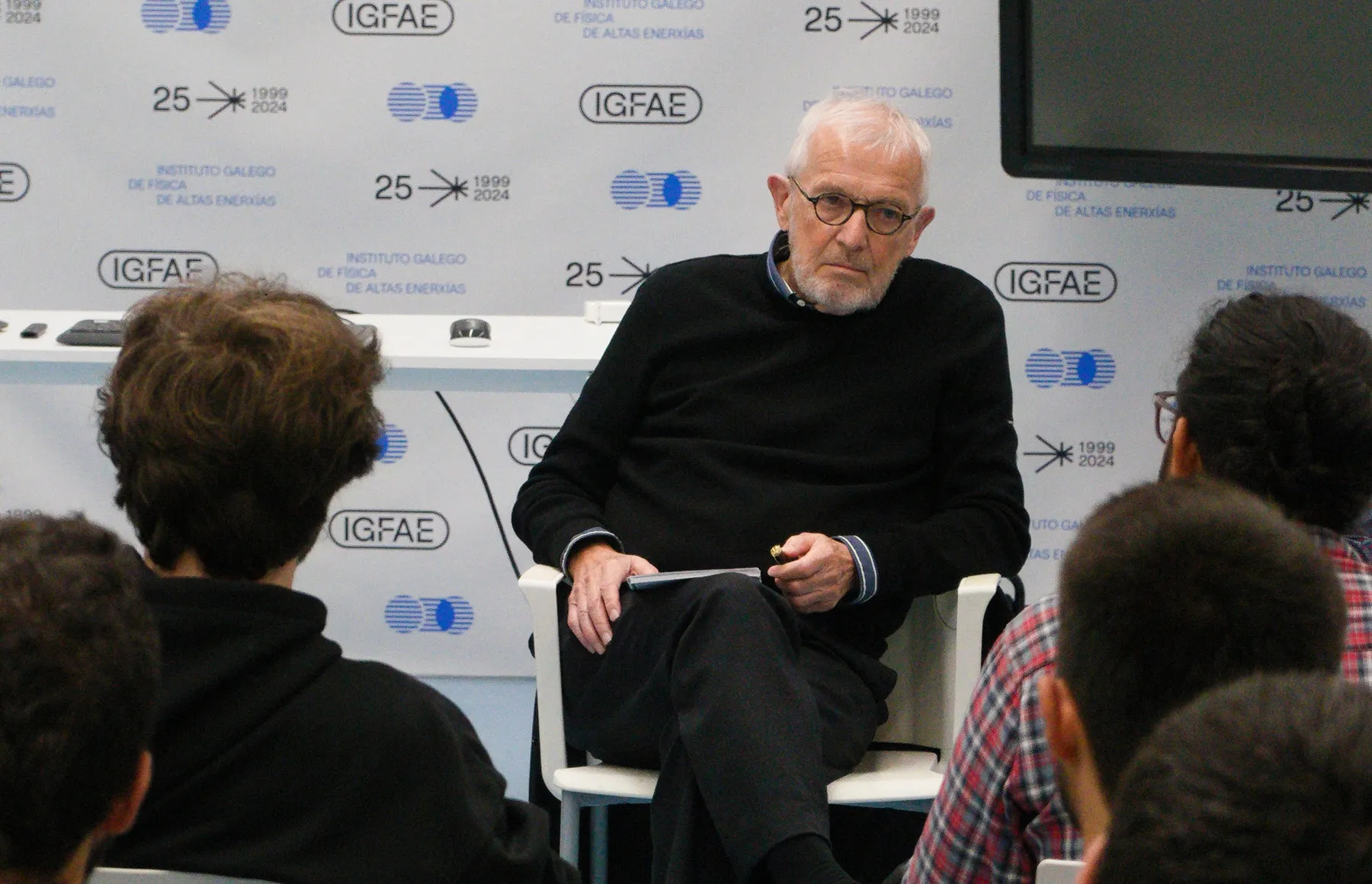
The Galician cosmologist from A Coruña, Antón Baleato Lizancos, has just been awarded an ERC Starting Grant from the European Research Council (ERC). Antón will develop the ACCELLENS project at IGFAE, funded with €2 million, through which he aims to investigate why the expansion of the universe is accelerating. Thanks to the award of this grant, he returns to Galicia after developing his entire research career in the United States and the United Kingdom.
The Starting Grants are aimed at researchers who are starting their own independent research team or programme. The beneficiary staff leading the projects must demonstrate the innovative nature, ambition and viability of their scientific proposal. This ERC call is one of the most prestigious in Europe, and supports research projects at the forefront of knowledge led by researchers between 2 and 7 years after the defence of their doctoral thesis. With Antón Baleato, the IGFAE adds its second ‘Starting Grant’ researcher, together with César Cabrera, who joined the Institute in the first half of 2026 to develop a project on quantum simulation, hired as an Oportunius distinguished researcher since last August. Baleato, who was a beneficiary of the ERC support for candidates from the Oportunius programme, will also be able to apply for the next calls for distinguished researcher positions from the Oportunius programme to retain, attract and return research talent.
Analysing the cosmic microwave background and the distribution of galaxies
As the researcher explains, “it is well known that since its beginning, with the Big Bang, the Universe has been expanding. But what is potentially even more interesting for Physics is that, during its earliest moments, the rate of expansion underwent a brutal acceleration which, after a fraction of a second, disappeared”.
The mystery, however, does not end there, as Antón Baleato emphasises: “Six billion years later, the acceleration has returned, and today it is causing the Universe to expand faster and faster. Why? What is the engine behind this acceleration, and what does it reveal about the fundamental laws of nature?”. These are some of the questions that the cosmologist aims to solve through his research.
Within this framework, “the ACCELLENS project (acronym for Cosmic ACCELeration through a new gravitational LENS: the synergy between galaxies and the CMB) seeks to answer these questions by exploiting synergies between the oldest light we can detect (the Cosmic Microwave Background) and the distribution of galaxies in the Universe”, he explains.
As a bridge between both sources, the research will study what is known as the gravitational lensing effect. Due to this effect, “the mass of galaxies and the dark matter surrounding them distort this background light and help us to better understand what the Universe is made of and how it is expanding”, the Galician researcher points out.
“Furthermore —Antón Baleato adds— these distortions need to be removed to study the early Universe. By applying these techniques to data from leading telescopes such as the Simons Observatory and the Dark Energy Spectroscopic Instrument (DESI), the ACCELLENS project aims to reveal why the Universe expanded at an accelerated rate at the beginning of time, and why it is doing so again today”.
Antón Baleato Lizancos
Antón Baleato Lizancos graduated in Physics from Columbia University (USA) and then completed a master’s degree in Theoretical Physics and Mathematics at the University of Cambridge (United Kingdom), followed by a PhD in cosmology at the same institution. Since 2021, he has been a postdoctoral researcher at the University of Berkeley and Lawrence Berkeley National Lab (USA). He also recently received the Fundación la Caixa Junior Leader postdoctoral fellowship, which funds projects developed at centres of research excellence in Spain or Portugal.
Antón plays a leadership role in the Dark Energy Spectroscopic Instrument (DESI), where he coordinates the joint analysis of galaxy clustering together with the imprint they leave on the cosmic microwave background through gravitational lensing. He is also heavily involved in the Simons Observatory (SO), where he leads the “delensing” group, which will obtain the most precise measurements of the presence (or absence) of gravitational waves generated moments after the Big Bang. In the coming years, the high complementarity between DESI and SO promises to reveal much about the nature of dark energy and dark matter, neutrinos and the early Universe.
“The most I could have hoped for”
The award of this grant represents, in the words of the physicist from A Coruña, “the most I could have hoped for, both professionally and personally: being able to do science under dream conditions, building a strong research group strategically positioned in two of the world’s leading experiments, such as the Simons Observatory and DESI”.
Antón also highlights the opportunity to return homeland to continue his career: “On top of that, being able to do it in Galicia, returning after spending half my life abroad. I am especially excited to join IGFAE because of the place it has achieved within Galicia’s scientific and cultural fabric, and its clear determination to continue growing”.
With Antón’s arrival, the Institute receives a new boost for its research area in Cosmic Particles and Fundamental Physics. HERON, another ERC project (in this case, under the Synergy Grant call) being developed at IGFAE, also falls within this field of work and is led by Jaime Álvarez-Muñiz. IGFAE staff also hold leadership and responsibility positions in major astroparticle physics collaborations such as the Pierre Auger Observatory, LIGO, NEXT and HyperKamiokande.