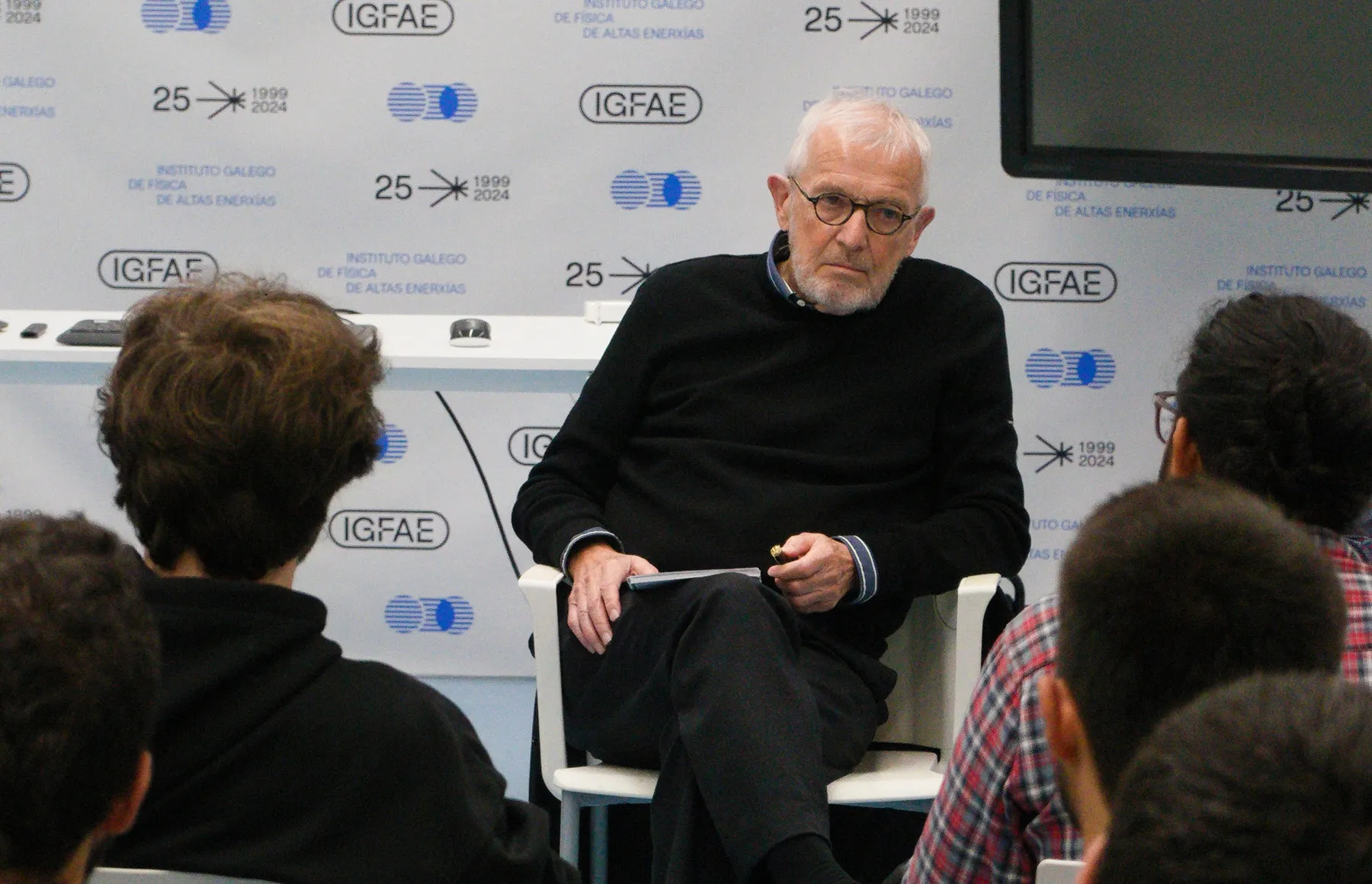
Francis Halzen (Tienen – Belgium, 1944), was awarded the 2026 Nobel Prize in Physics this Tuesday for his decisive contributions to the IceCube neutrino observatory, and for the discovery of high-energy neutrinos of astrophysical origin. The recognition is a close one for the staff of the Galician Institute of High Energy Physics (IGFAE), a joint center of the USC and the Xunta, with whom Halzen has maintained a close collaboration for almost 40 years.
Collaboration with Enrique Zas, Ricardo Vázquez and Jaime Álvarez-Muñiz
In the mid-1980s, Enrique Zas Arregui, now professor of Theoretical Physics at USC and member of the IGFAE, was a postdoctoral researcher with Halzen at the University of Wisconsin. And it was in the conversations with the Galician researcher that, according to the now Nobel Prize winner in Physics, the idea of building an observatory to detect neutrinos in ice emerged, thanks to the resolution of a problem that the Galician researcher solved “brilliantly,” says Halzen. That was the germ of IceCube, the project located in the Antarctic ice that has just won Halzen the Nobel Prize. Enrique Zas’s contribution is also mentioned in the scientific document itself that accompanies the Nobel award.
Another of the Belgian physicist’s collaborators at the IGFAE was Ricardo Vázquez López, who passed away at the end of 2022, for whom he supervised two doctoral theses, one of which was co-supervised with Enrique Zas. Vázquez’s contributions were relevant to the development of IceCube. On the occasion of the visit to Santiago for the defense of Ricardo Vázquez’s thesis, Halzen presented the bases of the proposal for the construction of the Antarctic observatory at the Faculty of Physics of the USC.
Similarly, some of Halzen’s most cited papers on neutrino and cosmic ray detection are co-authored, along with Zas and Vázquez, with IGFAE physicist Jaime Álvarez-Muñiz, who was also a postdoctoral researcher with the Nobel Prize in Physics. Álvarez-Muñiz recently obtained an ERC Synergy Grant for the HERON project , based on the detection of very high energy neutrinos, the topic on which he had worked with Halzen.
Member of the Scientific Advisory Committee of the IGFAE
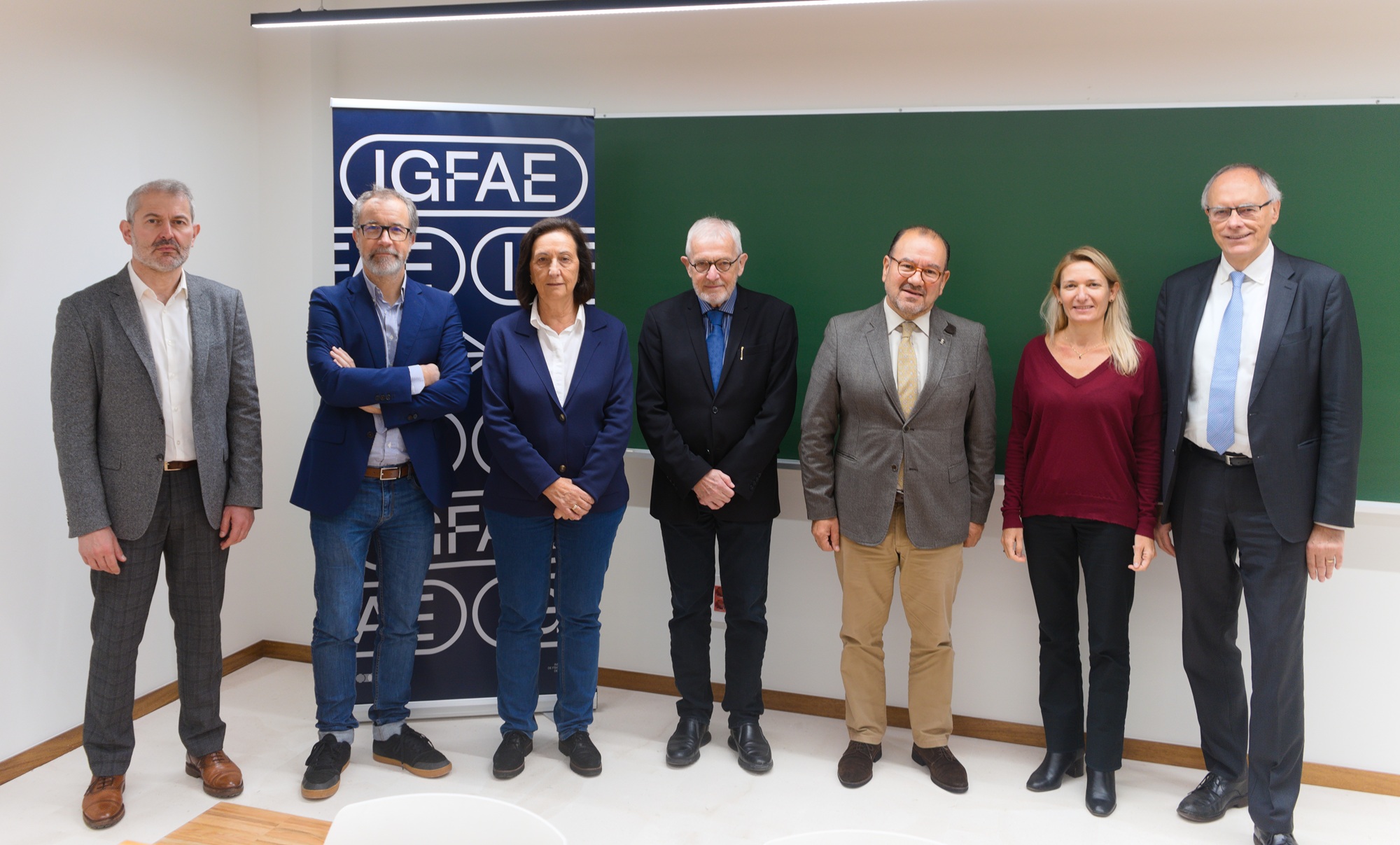
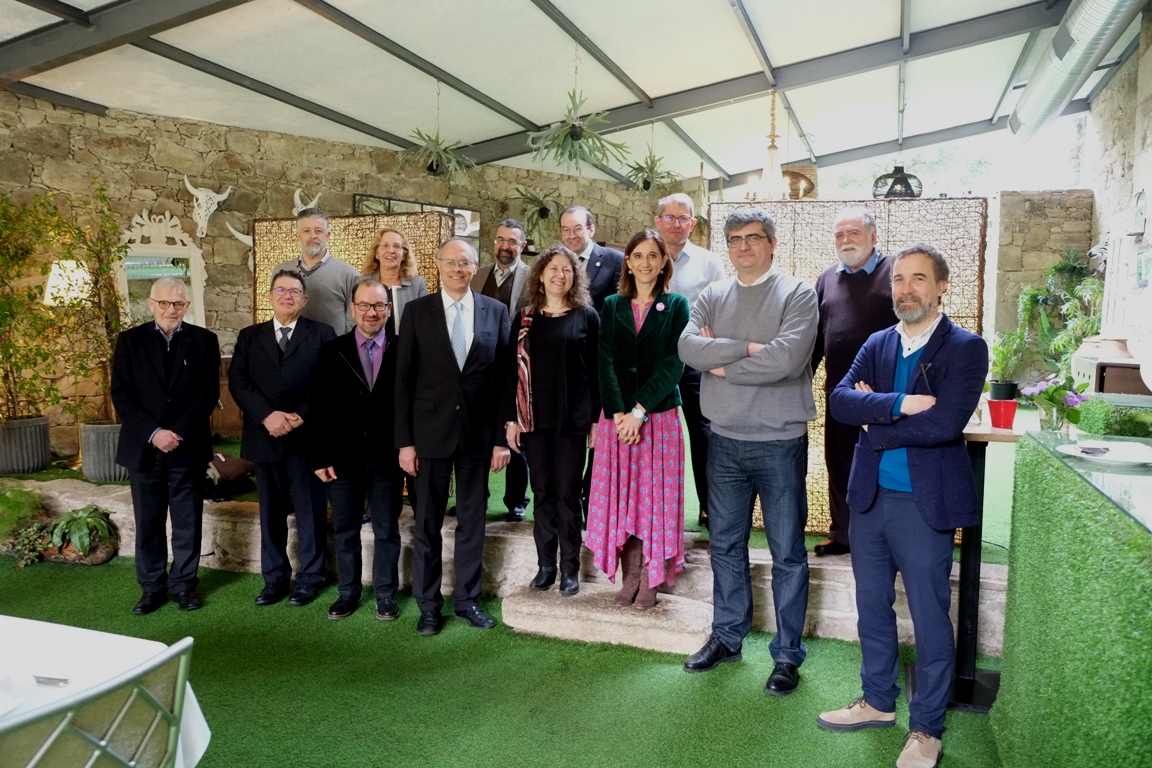
Francis Halzen (centre), at the 2024 IGFAE SAB meeting.
{%CAPTION%}
The IceCube experiment leader’s connection with Galicia extends to the IGFAE Scientific Advisory Committee, which he currently chairs. Halzen has visited Santiago de Compostela on several occasions. The last of these was in 2024, at the last meeting of this committee, held in the institute’s new facilities.
IceCube: An observatory on Antarctic ice to detect neutrinos
The main objective of IceCube is the detection of neutrinos, subatomic particles with a very small mass, which barely interact with the rest of the matter and can cross the entire Earth without being detected. In this context, the ice of the South Pole, where the observatory is located, is free from interference and seismic movements that can complicate the detection of neutrinos, making it an ideal location for this type of experiment.
After two decades of design and construction, IceCube became operational in 2011. It soon began detecting the first high-energy neutrinos from outside the solar system. These sources are expected to reveal invaluable information about the most violent phenomena in the universe.