Nuclear physics has spent decades trying to understand how protons and neutrons are organized within the atomic nucleus. Improving this knowledge is essential to understanding the origin and stability of matter, and to make more precise the models that describe phenomena such as the formation of chemical elements in stars, or the behavior of very rare and exotic nuclei that do not exist naturally on Earth.
In this regard, a work published in the journal Physical Review Letters , and led by IGFAE staff, has just shed more light on the energy levels of light nuclei. The research is led by Juan Lois Fuentes (IGFAE PhD student when the experiment was conducted) and Beatriz Fernández Domínguez, IGFAE researcher, and was developed in the ACTAR – TPC experiment of the GANIL accelerator, located in CAEN (France), where the Institute’s staff has been involved for more than two decades.
Getting to know the layer model better
The work focuses on what is known as the “shell model” of atomic nuclei: although nuclei are usually represented in a compact way, they are composed of protons and neutrons (and quarks within each of them), which occupy different energy levels. When these levels are filled, particularly stable configurations emerge; known as ‘magic numbers’. For decades, research in nuclear physics has been investigating why these magic numbers appear, and how they change when neutron-rich nuclei are studied.
When a nucleus contains 6 or more protons, a gap opens between the energy levels of the 6th and 7th protons. Some indirect measurements have led to the idea that this gap persists when the number of neutrons is increased, which would make the atomic number (Z)=6 a magic number, closing the structure of this shell, as happens in the stable electron configurations of the noble gases.
In the experiment led by Juan Lois Fuentes and Beatriz Fernández Domínguez, a beam of oxygen-20 was directed towards a gaseous target of molecular deuterium, and the collisions that eliminated a proton to create nitrogen-19 were isolated. From the energies and populations of eight proton orbitals, it was deduced that the width of the Z=6 gap was 5.3 MeV, approximately 1.8 MeV less than in oxygen-16 (with four fewer neutrons). Therefore, this gap is not constant, but rather decreases as the number of neutrons increases.
Furthermore, the same work observed that this reduction is mainly due (95%) to the tensor interaction, a component of the nuclear force that depends on the relative orientation of their spins and positions. This behavior was already predicted in some theoretical models, but direct experimental data to confirm it were lacking.
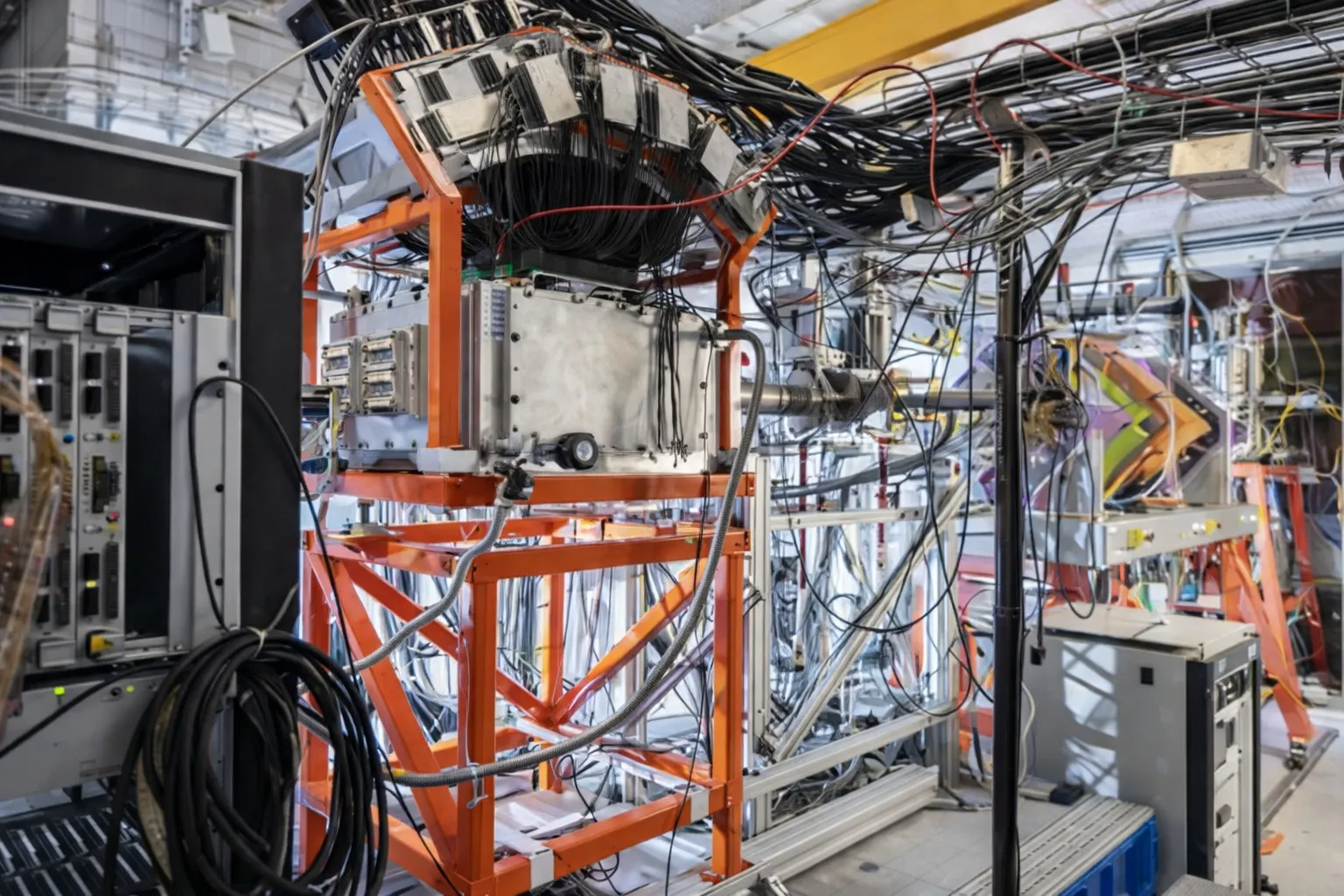
According to Beatriz Fernández, “these are the first results with the ACTAR TPC detector in direct transfer reactions to study the spin-orbit of exotic nuclei”. This detector is designed to study very exotic nuclei produced in radioactive beams. These are nuclei that are generated in extremely small quantities, but which are very interesting for better understanding the structure of the nucleus. It is also a complex challenge at a technical level, since making precise measurements in these tiny quantities is very difficult. The performance of ACTAR TPC, which allows increasing the luminosity of the analyses without losing resolution, was crucial to obtaining these results.
In addition to Juan Lois and Beatriz Fernández, researchers Manuel Caamaño, Cristina Cabo, Daniel Fernández and Daniel Regueira also participate on behalf of the IGFAE.