O Instituto Galego de Física de Altas Enerxías (IGFAE), joint center of the USC and the Xunta de Galicia, aims to coordinate the construction of the prototype of an essential part for the FCC, the Future Circular Collider of CERN (European Organization for Nuclear Research). The construction of the prototype will be a strategic initiative for R&D&I in Galicia, since it will involve both academia and the industrial fabric specialized in the field of particle accelerators. Given the magnitude of the project and its scientific, technical, and financial complexity, close collaboration at all levels is required. In this process, the CDTI promotes the procedure of the preliminary market consultation and Pre-Commercial Public Procurement; the Xunta, through the Galician Innovation Agency, acts as the public buyer; and the IGFAE, as the scientific-technical promoter, is the knowledge center that defines, monitors, and validates the prototype.
With the aim of building this prototype in Galicia, the preliminary market consultation is now being launched so that companies interested in its manufacture may express their interest until July 9. Next June 23, a workshop will be held at the IGFAE headquarters in Santiago de Compostela to explain to interested stakeholders the keys to participation in this process, as well as its objectives and scope at the Galician, national, and international levels. Those interested in participating may already register through the enabled link.
Through this consultation, the aim is to determine the degree of development of innovative and relevant technologies in the field of particle colliders to carry out the complete prototyping and pre-industrialization of a representative section of the Future Circular Collider (FCC–Future Circular Collider). This consultation marks the beginning of the innovative public procurement process in the modality of pre-commercial contracting carried out by the CDTI and intended to articulate the participation of companies and other agents of the R&D&I ecosystem in this challenge.
A prototype for a 43-meter long ‘mock-up’
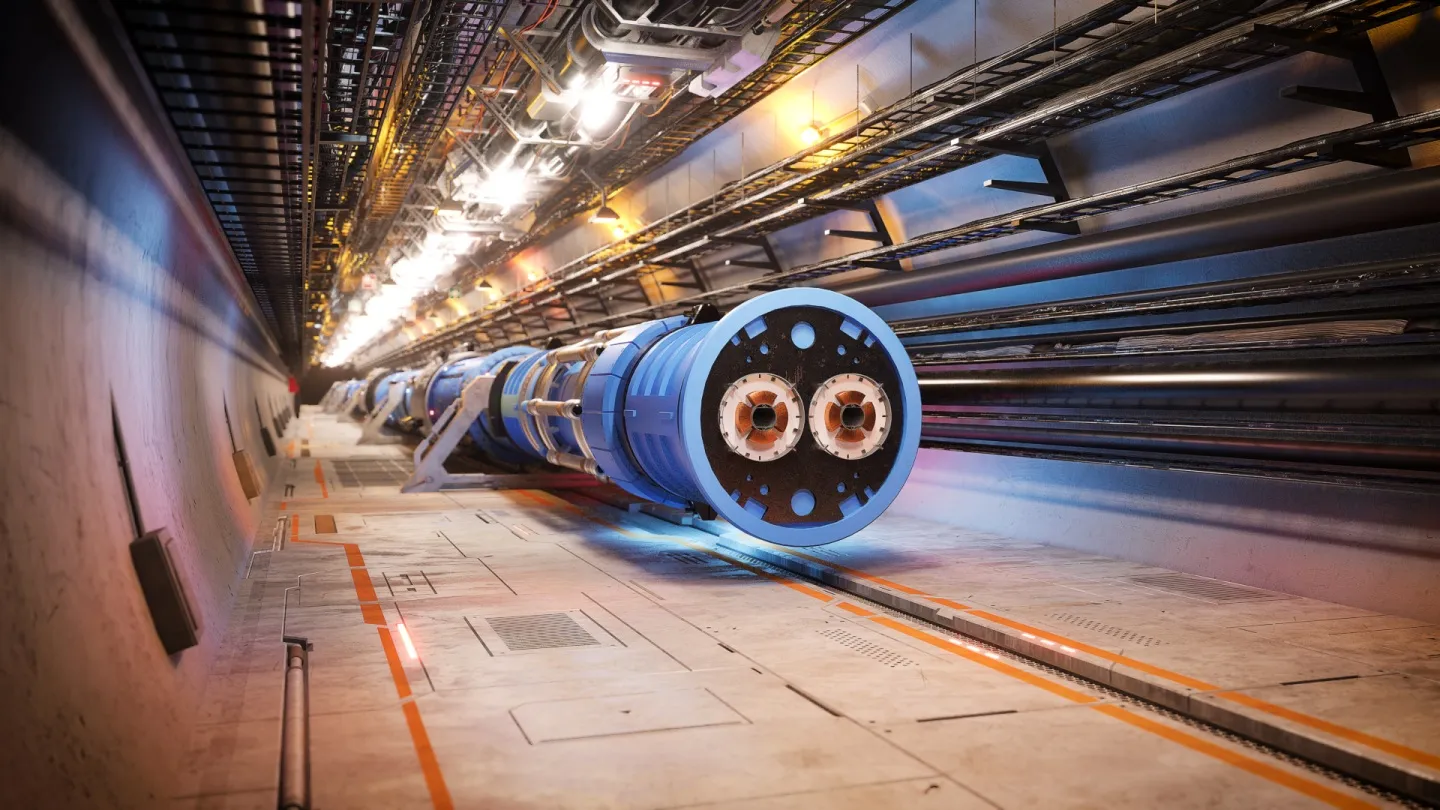
In order to design and test all the components of the first phase of the future FCC, the construction of a 43-meter-long mock-up is planned, in which the prototypes to be developed in the respective countries involved in the project will be assembled. When the FCC is built, this mock-up, conceived as a basic unit called an arc cell, will have to be replicated up to 2,000 times until the entire circumference is completed.
Each of these cells will contain dipole magnets to bend the particle beam, as well as quadrupole and sextupole magnets that focus and defocus this beam. The latter are contained in a subunit called the Short Straight Section (SSS), which is the specific subject of this proposal. For this purpose, a test bench with a full-scale design will be developed, which will be assembled and commissioned at the facilities of the IGFAE itself, and later validated at CERN.
Industrial return, a founding objective of the IGFAE
According to the director of the IGFAE, Carlos Salgado, this project “connects with one of the founding objectives of the Institute, the promotion of industrial activity in technologies related to particle physics.” The construction of this equipment for the future FCC represents a “flagship project” for Galicia and its R&D&I fabric, both in scientific and technical training and in the creation of highly qualified employment.
The IGFAE’s leadership in this initiative is the result of the long collaboration between the IGFAE and CERN, which dates to the last decade of the 20th century. More than one third of the Institute’s staff is attached to CERN; mainly in the experimental area through the LHCb collaboration (to which the recent incorporation into CMS must be added), but also from the theoretical perspective.
In this regard, the Institute’s new facilities, inaugurated in 2025 with an investment of 5 million euros by the Xunta de Galicia, will make it possible to establish in the IGFAE laboratories a test bench to validate designs, systems integration, materials, and the maintenance and handling of the equipment that will be integrated into the FCC. Likewise, the technologies developed in this project could be used in future experimental facilities beyond CERN.
From the IGFAE, in addition to Carlos Salgado and Abraham Gallas, the project will be coordinated by researcher Néstor Armesto (coordinator of the Institute’s strategy for new scientific infrastructures) and engineer Antonio Fernández Prieto.
An unprecedented scientific and technical challenge
The construction of the future FCC will be an unprecedented challenge, not only for particle physics, but also for civil engineering. It is planned to excavate, at a depth of 200 meters, a tunnel with a circumference of 91 kilometers, in which particles will be accelerated and collided at speeds close to the speed of light, near absolute zero (-273°C), and in a vacuum like that of outer space. The estimated cost is around 15 billion euros.
To create these conditions, instruments resistant to extreme conditions of temperature, pressure, and radiation are required. In addition, another major challenge, as highlighted by the team involved in the project, is stability—at the nanometric scale—and resistance to any vibration, with the objective of achieving the greatest possible number of particle collisions. Likewise, any intervention in the system must be carried out with the highest possible efficiency and automation, reducing the downtime required for accelerator maintenance compared with the current LHC.
The FCC: a gateway to the origin of the universe
In May, the CERN Council updated the European Strategy for Particle Physics, confirming the FCC as the preferred option to succeed the current LHC once it ends its activity at the beginning of the 2040s. The final decision on its construction will not be taken until 2028, although the CERN community has been working on its design for many years.
The FCC would triple the size of the current LHC (from 27 to more than 90 km in circumference).
If the project moves forward, construction works will begin in the 2030s, with the expectation of entering service toward the end of the 2040s and operating until the end of the 21st century. Once in operation, and after a phase of collisions between electrons and positrons (antielectrons), the FCC will be able to collide protons and other atomic nuclei at much higher energies. All these studies will make it possible to better understand the fundamental elements of matter and, possibly, answer some of the mysteries that persist regarding the origin of the Universe, such as the nature of dark matter, which occupies most of the cosmos. In addition, the knowledge and technological innovation developed for its construction will have applications in a wide variety of sectors, with social impact.