This week, the IGFAE headquarters is hosting a meeting of its Scientific Advisory Board (SAB). This body, made up of internationally renowned figures in different fields of physics, includes among its members Francis Halzen, who was recently awarded the Nobel Prize in Physics in October this year for promoting the IceCube neutrino observatory.
On Thursday 5 and Friday 6, the committee will hold several working meetings with Institute staff in order to assess its scientific performance and strategy for the coming years. The meeting’s agenda also includes the ongoing procedure for selecting the new IGFAE leadership, as well as the development of new research lines in quantum science and technology and cosmology.
The sessions began this Thursday with the presentation of the report by the Institute’s Director, Carlos Salgado, outlining the main achievements of recent years, such as the renewal of its accreditations as a María de Maeztu Unit of Excellence and as part of the CIGUS network, as well as the opening of its new headquarters. Subsequently, staff from the astroparticle and nuclear physics areas presented reports on their respective research programmes. There was also an opportunity for a meeting with predoctoral and postdoctoral researchers, who discussed the working environment and scientific and training prospects in the early stages of a research career with the SAB.
The day continued with a visit to the Institute’s new facilities and a presentation of the new members of IGFAE’s staff, who joined through its own Global Talent recruitment programme and competitive calls such as Ramón y Cajal, Junior Leader from the ”la Caixa” Foundation, and the European Research Council’s Starting Grants.
Reception with the USC Rector this Friday
On Friday, the day will begin with USC Rector Rosa Crujeiras receiving Nobel laureate Francis Halzen at the Colegio de San Xerome. Immediately afterwards, also at the Rectorate, the SAB will meet with the IGFAE Governing Board, the main decision-making body within the centre’s structure, comprising representatives of USC and the Xunta de Galicia.
The SAB’s work will conclude with a closed meeting of the advisory committee, which will produce the assessments and recommendations that will guide the centre’s strategy for the coming years, as well as the mandatory report for the selection of the new leadership. The committee’s proposals are essential to IGFAE’s operating model, since these external assessments analyse the degree to which the main scientific objectives and research programmes have been achieved, guiding the strategy for the coming years with the aim of maintaining the Institute as a leading centre in its field.
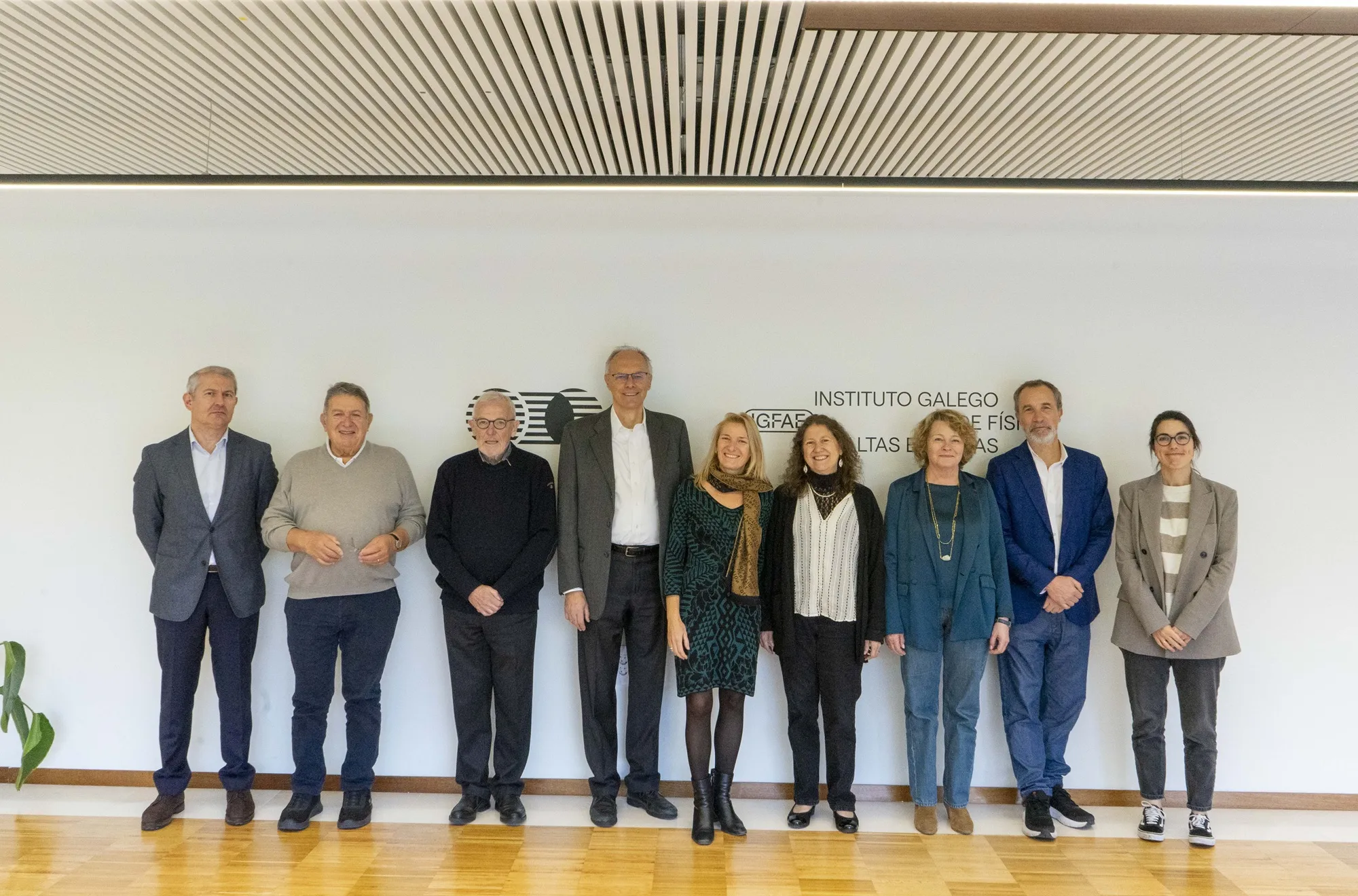
Members of the IGFAE SAB
Alongside Halzen, the other five members of the advisory committee were in Santiago de Compostela. They are internationally recognised figures in the research areas in which IGFAE works, including particle physics, nuclear physics and gravitational waves.
The other committee members are Sergio Bertolucci, Professor at the University of Bologna and CERN Scientific Director from 2009 to 2015; Barbara Erazmus, Research Director at the Centre National de la Recherche Scientifique (CNRS), Deputy Director of NuPECC and spokesperson for the CERN ALICE Collaboration from 2020 to 2022; Paolo Giubellino, President of the Commissione Scientifica Nazionale III of the Istituto Nazionale di Fisica Nucleare, Scientific Director of GSI-FAIR from 2017 to 2024 and spokesperson for ALICE from 2011 to 2016; Gabriela González, Professor at Louisiana State University and spokesperson for the LIGO Collaboration from 2011 to 2017; and Giulia Zanderighi, current Director General of the Max Planck Institute for Physics.