The CODEX‑b collaboration at CERN has achieved, in an important milestone, the recording of the first data with the prototype of its CODEX‑beta detector, installed at the Large Hadron Collider (LHC). This represents a key step toward demonstrating the search capabilities of this new class of detectors, focused on the search for the so‑called “dark sectors”, particles and fields beyond the Standard Model as we know it, which remain elusive for the current LHC detection systems.
These hidden sectors could provide answers to some of the major unresolved mysteries in physics, such as the composition of dark matter, the origin of the matter–antimatter asymmetry in the universe, or the naturalness of the electroweak vacuum.
CODEX‑b (acronym for COmpact Detector for EXotics at LHCb) was proposed in 2017 by a collaboration of four scientists from Lawrence Berkeley National Laboratory, the University of Cincinnati and the LPNHE in Paris. Since then, the collaboration has grown to more than 60 members in 20 institutions around the world. And Galicia, through the IGFAE and the University of A Coruña, has a relevant role in this collaboration.
On the IGFAE side, the team is led by Xabier Cid, physics coordinator of the project, and also includes Miguel Fernández Gómez, Alberto Martínez Armas, Pablo Menéndez-Valdés, Alejandro Novo Cal, María Pereira Martínez, Emilio Xosé Rodríguez Fernández and Alejandro Rodríguez González. Contributions from the UDC also had a critical impact, with a team led by Carlos Vázquez Sierra, software development coordinator and deputy physics coordinator of the project; and Titus Mombächer, technical coordinator of CODEX-b.
In this sense, the collaboration between both groups at IGFAE and UDC was key to meeting the necessary deadlines for data collection before the end of Run 3, the last data collection period of the LHC, at the end of June 2026.
Shifting the focus toward “long‑lived particles”
The purpose of CODEX‑b is to shift the focus toward long‑lived particles, which tend to appear far from the collision points where the LHC detectors are looking. The key to the experiment is a special “actively shielded, zero‑background” environment, where only these hidden long‑lived particles can appear before decaying.
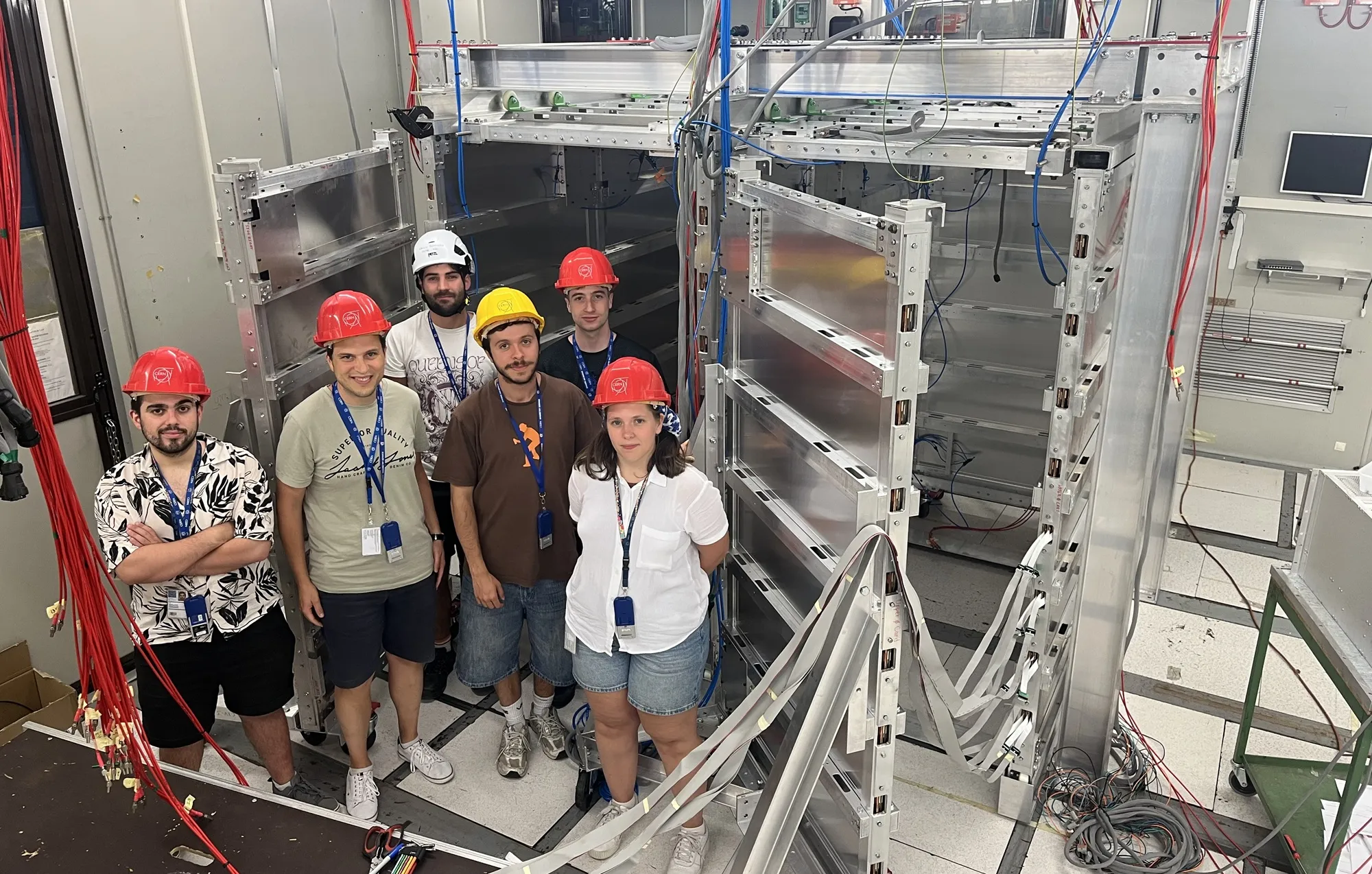
The collaboration is currently working with the CODEX‑beta prototype, a 1:5 scale version of CODEX‑b, with an approximate volume of 2 m³. Its main purpose is to take critical measurements needed to design the active shielding of the full‑size detector and to optimize the detector concept, which is also used in other proposed devices for long‑lived particles. Despite its small size, CODEX‑beta can also explore some new scenarios of new physics.
Emilio X. Rodríguez, one of the IGFAE researchers participating in the process, highlights: “The installation of the CODEX-beta demonstrator is an unprecedented milestone, highlighting the transversal collaboration of a large group of researchers who, even coming from different contexts, unite in achieving a common goal. We are facing a unique opportunity to do physics differently and, why not, solve a paradigm of current physics such as dark matter.”
“Designing and building this prototype has required a tremendous effort from a small group of experimental physicists, theorists, and engineers, many of whom donated their spare time to the effort,” says Philip Ilten, professor at the University of Cincinnati and spokesperson for the experiment. “The data from this prototype will be essential to realizing this type of detector concept, showing that we really can search for new physics this way”
The full-sized CODEX-b experiment, if approved by CERN, will occupy a fortuitously available space adjacent to the LHCb detector within the LHC’s interaction point 8 cavern. Approximately 10x10x10m3 in size and utilizing detector technology designed for ATLAS, the CODEX-b detector will be able to explore a very broad range of New Physics scenarios, ranging from axion-like particles to heavy neutral leptons, to light scalar particles coupling to the Higgs boson.
“Even though the long-lived particles CODEX-b will search for are quite light in mass compared to the Higgs boson, being near an LHC collision point allows the experiment to explore exotic interactions with the Higgs boson itself”, explains IGFAE researcher Xabier Cid. “Understanding how the Higgs interacts could be at the core of many open problems in particle physics today, so passing this milestone for CODEX-beta is really exciting”, he concludes.
“It was an immense experience, and a great achievement, to be able to build and launch the CODEX-β prototype. Its success demonstrates the operation of a completely new concept for searching for new physics,” says UDC researcher Titus Mombächer. For his part, Carlos Vázquez Sierra, Ramón y Cajal researcher at UDC, says: “The integration into the data acquisition system of the LHCb experiment, as well as the development of a new processing and analysis system, was one of the most relevant milestones that contributed to the monumental success of the project.”