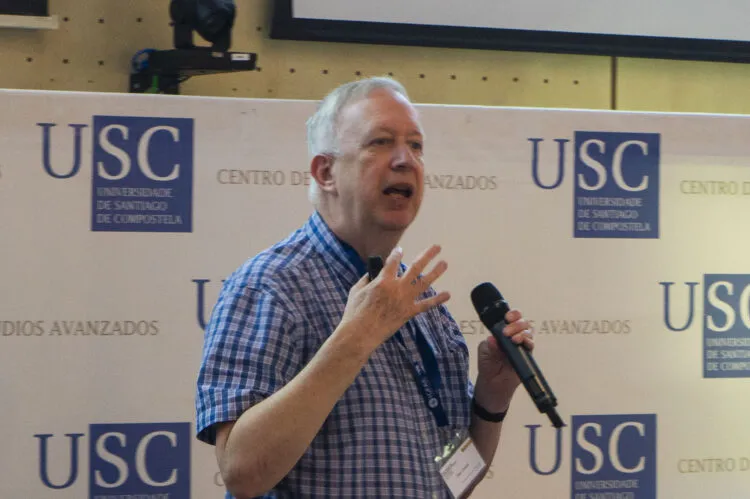



The Instituto Galego de Física de Altas Enerxías (IGFAE), a joint centre of the University of Santiago de Compostela (USC) and the Xunta de Galicia, will host, from 8 to 12 June, 2026, the conference ‘Data Science and Complexity in Fundamental Physics and the Bridge to the Industry and Society‘. The meeting aims to promote dialogue between academia and industry, as well as to highlight professional opportunities for people interested in data science and its applications to society and business.
The meeting, consisting of a school for young researchers as well as a symposium with the participation of companies from a wide range of sectors, with data science as nexus, will be held for the second time in Santiago de Compostela after previous editions in Portugal (Lisbon, Braga and Coimbra).
About

Data Scientist is one of the most sought-after jobs of the moment. Social Networks, Large Retail companies, Pharmaceutical, consulting and telecommunication companies, all the Fortune 500 companies are hiring Data Scientists. Everywhere, everyone. Data Science is the art of analyzing data sets to find correlations, causal relations, patterns; build hypothesis, assign significances to them, assess the efficiency of an algorithm of finding a signal probability of false positives, assess the efficiencies of finding a signal. Define control samples, simulate and replicate the reality according to a model. Access, store, retrieve data, moderate or extremely large data-sets (Big Data); create automatic tools that take decisions…
Social Physics, Econophysics, and Complexity are related interdisciplinary fields that use concepts and methods from physics to study various systems’ behavior and dynamics. They intersect with Data Science and Fundamental Physics in several ways:
Social Physics employs mathematical tools and concepts from physics to analyze social phenomena, such as human behavior, collective decision-making, and information dissemination. Data Science plays a crucial role by offering advanced techniques for data collection, analysis, and visualization. Insights from Fundamental Physics help develop models that capture the patterns and mechanisms governing social dynamics.
Econophysics merges ideas from physics, especially statistical mechanics and complexity theory, with economics to investigate economic systems and phenomena. Data Science contributes by analyzing extensive economic and financial data to reveal hidden patterns and relationships. Fundamental Physics provides the theoretical foundation for developing mathematical models that can explain and predict economic systems’ behavior.
Complexity science studies complex systems with many interconnected components that display intricate behaviors, patterns, or outcomes. It aims to understand the governing principles of these systems and their emergent properties, which result from component interactions. Data Science assists in analyzing and modeling complex systems using tools that handle large-scale, multidimensional data and extract valuable insights. Fundamental Physics supplies a theoretical basis for understanding complex systems, as many concepts, like nonlinearity, feedback loops, and self-organization, originate from physical system studies.
The event aims to demonstrate the career opportunities within fundamental physics and its synergies with the job market and modern society’s needs. It will include a school covering Data Science techniques used in High Energy Physics (HEP), Nuclear, Astroparticle, and Fundamental Physics, alongside a symposium where companies present their current trends, needs, and daily work related to Data Science.
Additionally, the event intends to establish communication channels with the industry to explore partnerships, joint projects, and international grant opportunities. It will also highlight IGFAE’s research capabilities in Nuclear, High Energy, AstroParticle, and Fundamental Physics in the field of Data Science. By bringing together both sides, this event will create a framework for mutual knowledge exchange and enable the development of practical synergies from Data Science in fundamental physics to Data Science in the industry.
School
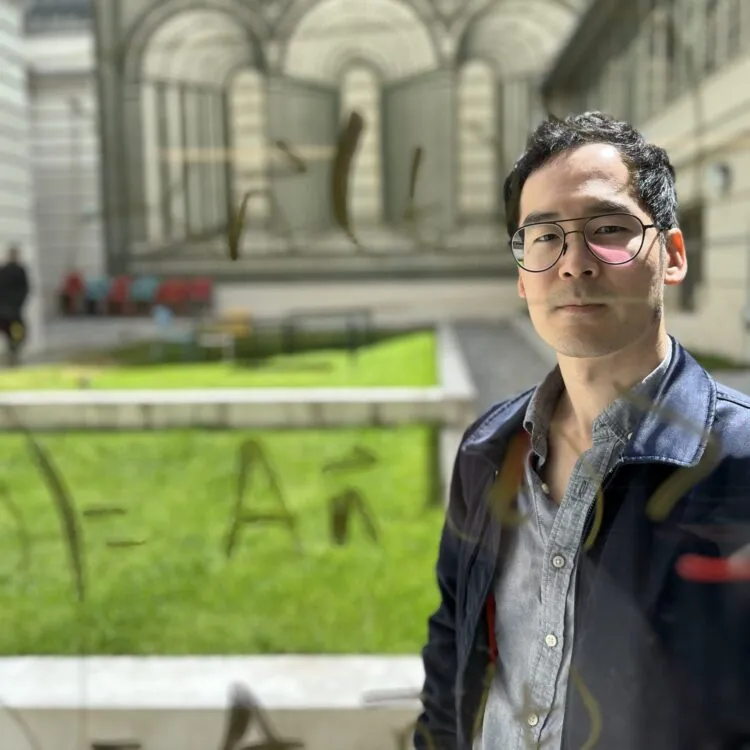
From 8 to 10 June there will be an intensive course on Probability, Statistics, Machine Learning and Complexity, focused on PhD students and postdoctoral research staff. The sessions will be led by Glen Cowan (Professor of Physics at the Royal Holloway in London) and Eddie Lee ((Assistant Professor of Physics at Seoul National University).
The school will be followed on 11-12 June by a symposium focusing on the relationship between fundamental physics and industry, with data science as the nexus.
During these days, more than 20 representatives from companies and research centres will discuss and share knowledge about the latest trends in the sector, the demands, and practical applications of data science in everyday life.
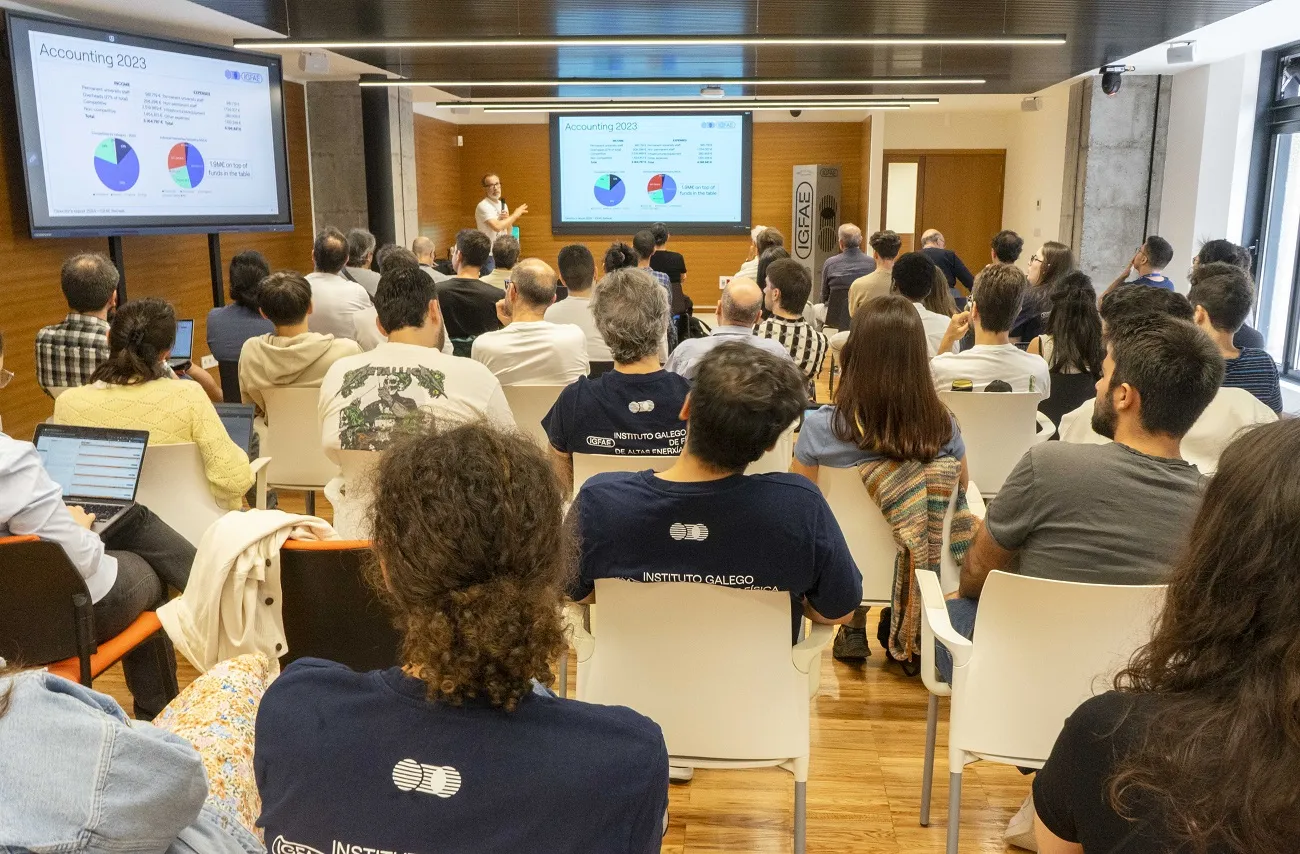
Data Science and Complexity in Fundamental Physics 2026 will take place at the new facilities of the Instituto Galego de Física de Altas Enerxías, located at the South Campus of the University of Santiago de Compostela.