Ordinary matter represents barely 5% of the Universe. The rest remains a mystery to Humanity: we do not know what composes it, nor how it behaves. It is estimated that most of it is dark energy, and the rest (around 27%) is dark matter, a substance that has mass and reveals itself through its gravitational attraction on galaxies, but that neither emits nor absorbs light and has never been directly detected in a laboratory.
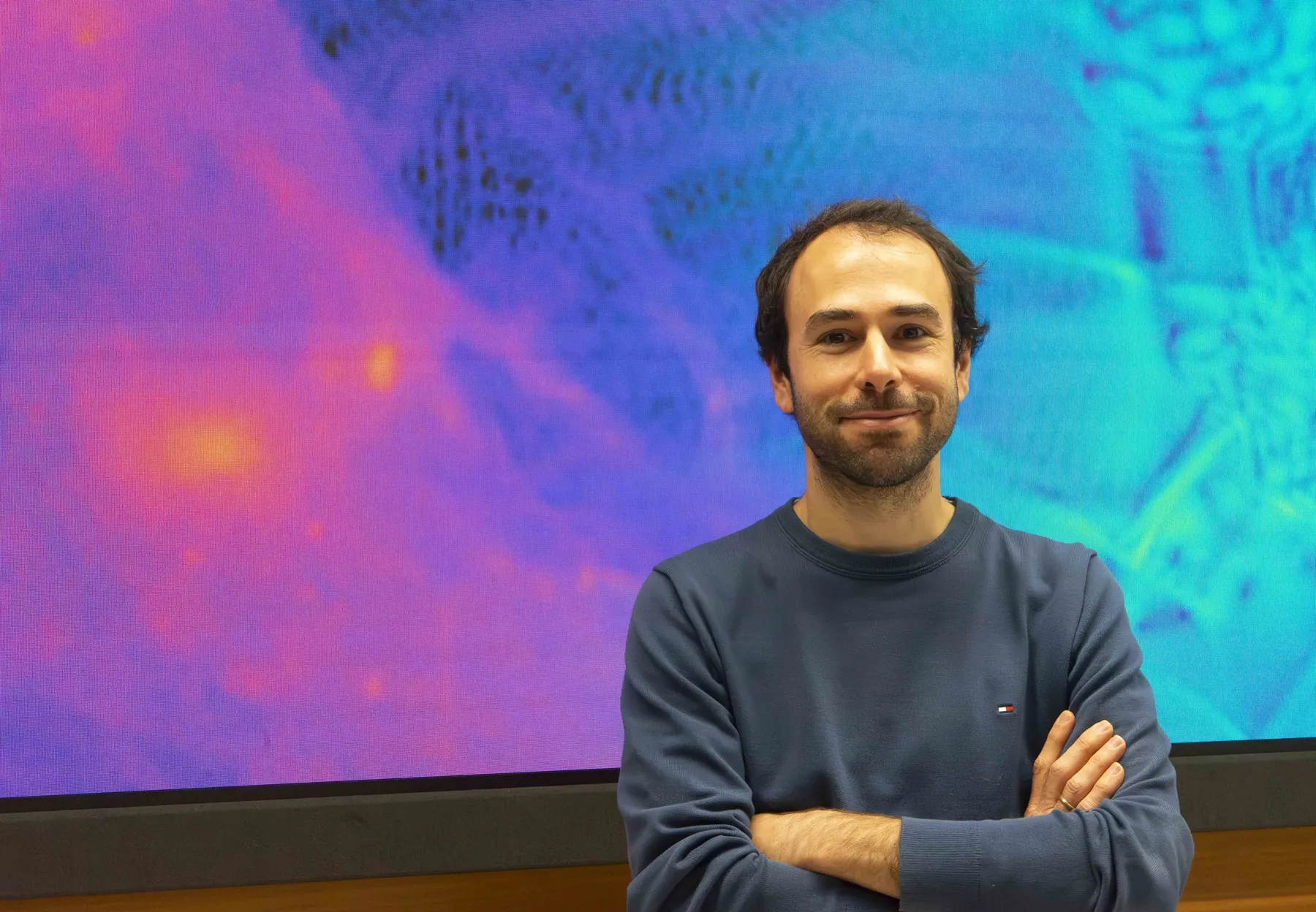
However, the scientific community does not give up and continues, from very diverse perspectives, to try to observe some signal. Gonzalo Alonso-Álvarez, a Ramón y Cajal researcher at the Instituto Galego de Física de Altas Enerxías (IGFAE), a joint center of USC and the Xunta de Galicia, has participated in an experiment to try to detect axions, a type of hypothetical particle that is a candidate to make up dark matter. Axions, if they exist, would be extremely light (billions of times lighter than the electron) and would permeate space as an invisible and oscillating field, producing periodic and very subtle perturbations inside certain atomic nuclei.
Ions trapped in a crystal near absolute zero
In the experiment, europium-153 ions embedded in an yttrium silicate crystal were used, cooled to -268 °C. As the IGFAE researcher explains, “europium-153 has a nucleus with a special shape that makes it particularly sensitive to the perturbation that an axion field would produce.”
Through precision spectroscopy, the researchers monitored the energy levels of the europium nuclear spins, searching for that characteristic signal that dark matter would leave. The statistical analysis was designed to take advantage of the specific properties of that signal—oscillating and coherent, with characteristics determined by the physics of the galactic axion field—which makes it possible to distinguish it from the random noise of the experiment.
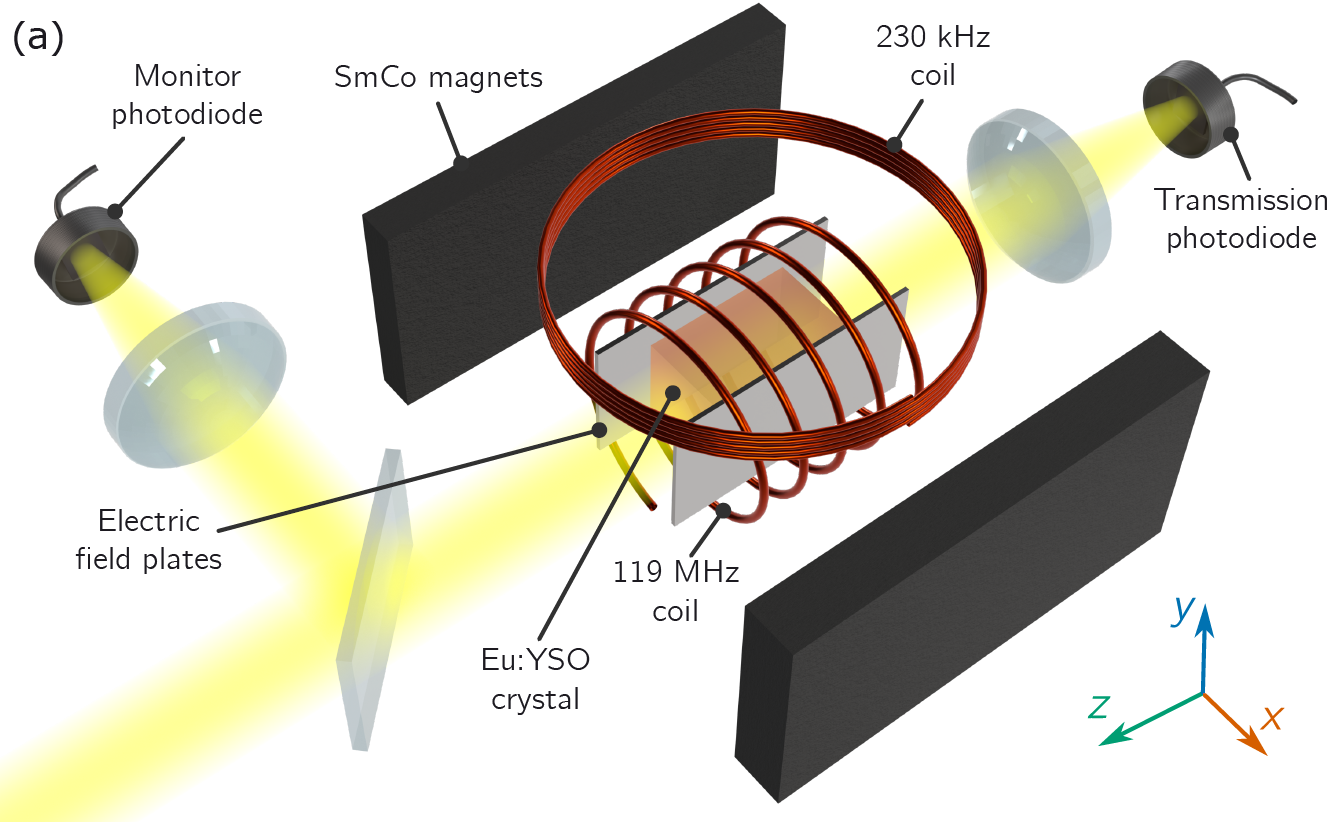
Ilustración esquemática do aparello experimental usado para a detección de materia escura axiónica. Imaxe adaptada de Fan, Mingyu et al. “Wideband Search for Axionlike Dark Matter Using Octupolar Nuclei in a Crystal” Physical Review Letters (2026).
No dark-matter signals, but some findings
This experiment did not find any signal of dark matter. But, as Gonzalo Alonso warns, “that is a result in itself: the data make it possible to establish one of the strictest laboratory limits to date on how axions can interact with the quarks and gluons of the atomic nucleus, in a mass range spanning eight orders of magnitude.” He adds that “these limits are also complementary to those imposed by astrophysical observations of stars and supernovae.”
Likewise, the team highlights that “this approach, based on quantum optics techniques and precision spectroscopy, opens a complementary path to large underground detectors and particle accelerators.” Improvements to this apparatus and to detection methods are foreseen, which allows anticipating that the sensitivity of the experiment will continue to grow in the future.
The results have recently been published in Physical Review Letters. In addition to Alonso-Álvarez, the article is signed by Mingyu Fan, Bassam Nima, Aleksandar Radak and Amar Vutha, from the University of Toronto, where the IGFAE researcher worked before his arrival in Santiago. In this article, his contribution focused on the design of the statistical analysis of the data: specifically, on how to consider the properties of the galactic axion field to identify the expected signal and distinguish it from experimental noise.
About Gonzalo Alonso-Álvarez
Originally from Zaragoza, he obtained his PhD in Physics at the University of Heidelberg (Germany) in 2020, with a thesis focused on axions and other light dark matter candidates. He subsequently carried out postdoctoral stays at McGill University (Montreal, Canada) and at the University of Toronto (Canada), where he collaborated with the experimental group with which the work described in this article was developed.
Gonzalo joined IGFAE in early 2026, having been recruited through IGFAE’s Global Talent programme, which is funded by the María de Maeztu accreditation for excellence awarded by the Spanish Research Agency. Thanks to this contract, he returned to Spain to continue his research career, and subsequently secured a contract under the Ramón y Cajal programme. Throughout his trajectory, he has explored the nature of dark matter from multiple angles: from theoretical predictions and searches in particle accelerators, to high-precision laboratory experiments and astrophysical and cosmological observations.
At IGFAE, Alonso-Álvarez will develop a line of research focused on developing and testing dark matter models, combining theoretical development with direct connection to experiments and astrophysical observations that make it possible to detect these particles.
Reference: Wideband Search for Axionlike Dark Matter Using Octupolar Nuclei in a Crystal (Phys. Rev. Lett. 136, published on March 25, 2026).