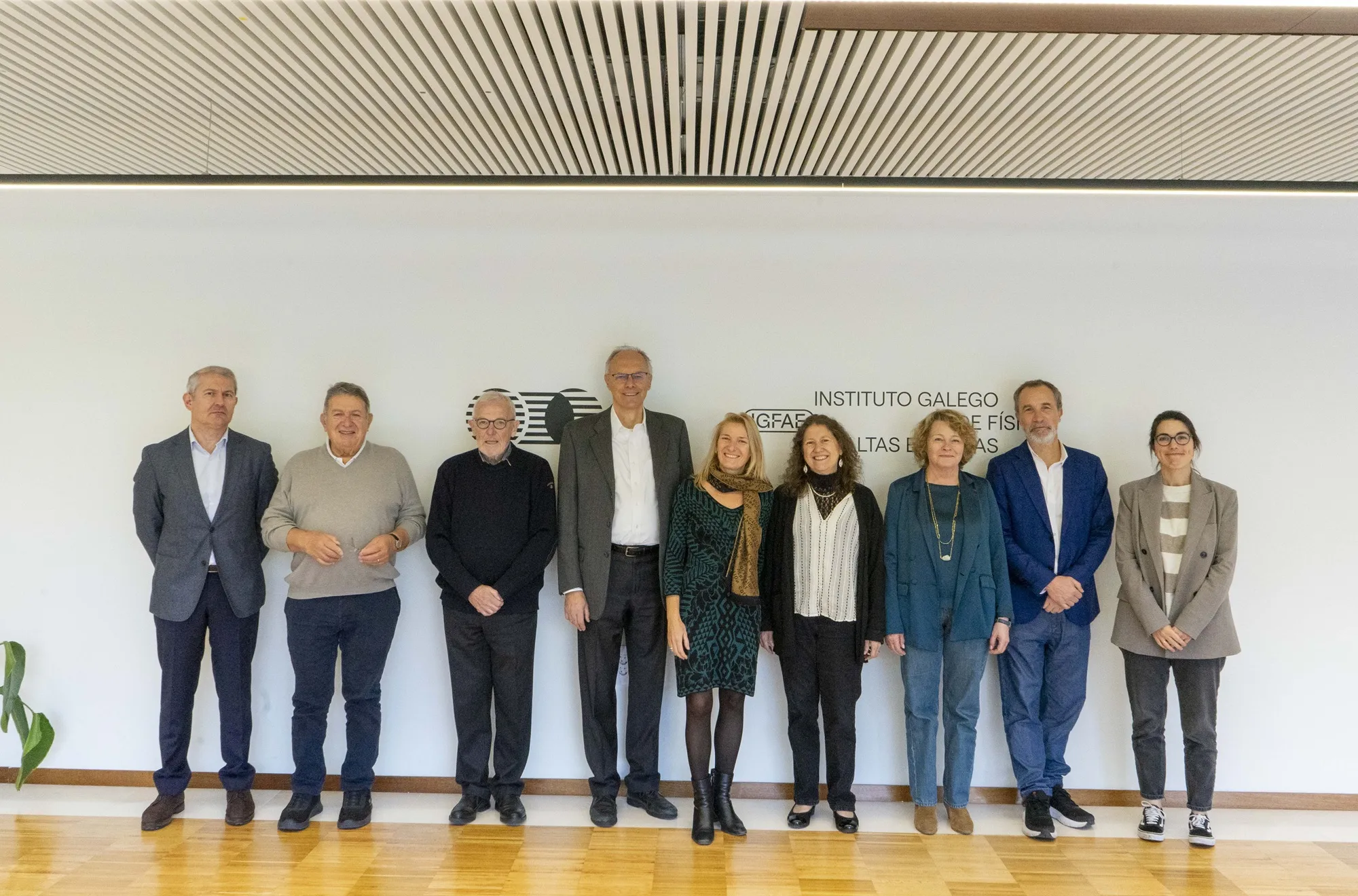
The IGFAE celebrates the ninth edition of Science Week, the annual event that aims to bring its research work to society, from 23 to 27 November 2026. On this occasion, the program will focus on the challenges and future opportunities that open up in the research areas in which IGFAE staff work.
Technological advances achieved in recent decades are offering a new window to better understand matter, from the fundamental elements to the exploration of the distant universe. Projects such as the Future Circular Collider (FCC) at CERN, the Einstein Telescope, the LISA space observatory for the detection of gravitational waves, experiments such as Hyper-Kamiokande, DUNE or IceCube for the detection of neutrinos – in many of which IGFAE staff is working – are called upon to expand the frontiers of physics and our knowledge in the second half of the 21st century.
Public talk by Michelangelo Mangano
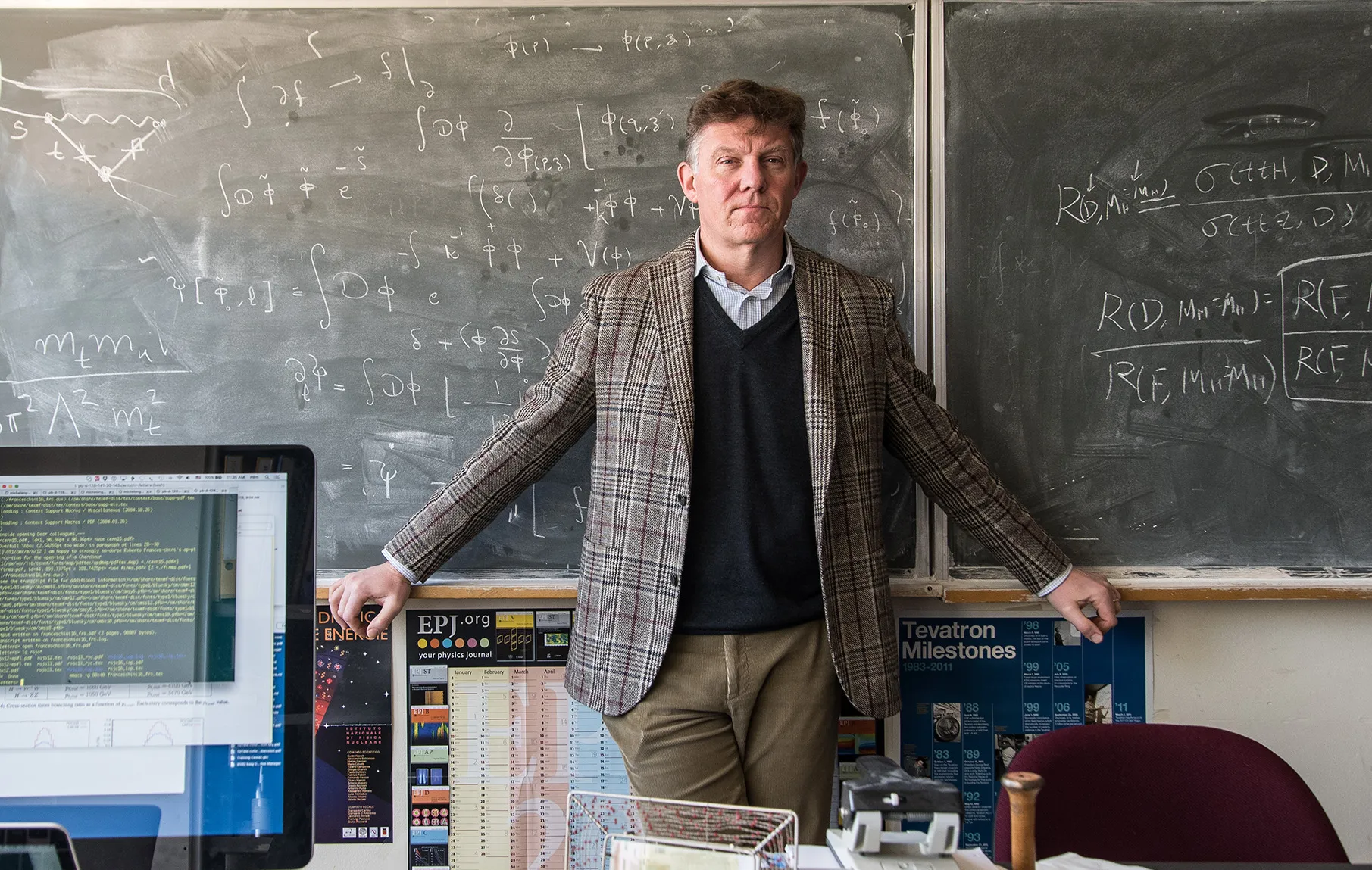
The central event of the Science Week (Casa das Máquinas, Wednesday 25 November, at 7:30 p.m., free admission) will be the conference of Michelangelo Mangano, an Italian theoretical physicist who led the LHC Physics Center at CERN, where he has been a senior scientist since 1995. His work focuses on the interpretation of data provided by the LHC experiments. Mangano is one of the coordinators of the physics program that explores the potential of the Future Circular Collider (FCC), the accelerator that is being studied to be built in the coming decades to expand our knowledge about the universe and the fundamental elements of matter.
Mangano will give the conference Colliding particles, to explore the Invisible , where he will delve into how particle accelerators help us understand the mechanisms that govern nature, from the fundamental elements to the largest scales of the universe. In this sense, projects like the FCC could open a new window to continue completing the pieces that we are missing to understand everything that exists, such as matter or dark energy.
Michelangelo Mangano obtained his doctorate from the Scuola Normale Superiore di Pisa. Later, he was a researcher in the Physics department of Princeton University (1984-1986), the theory group of the Fermilab laboratory in Chicago (1986-1988) and the Istituto Nazionale di Fisica Nucleare in Pisa, before joining CERN. Between 1988 and 2000, he worked at Fermilab’s Collider Detector (CDF), where he was part of the team that discovered the top quark in 1995.
In the field of outreach & education, Mangano created the High-School Teachers program at CERN in 1998, which offers training in particle physics to high school teachers. Through his outreach activity, he delves into the relationship between physics and the arts, approaching the work of artists such as Salvador Dalí to explain how creativity can help communicate and understand scientific concepts and reflect on the notions of the visible and the invisible.
NerdNite and colloquium “Falemos de FísicAS”
On Tuesday 24th (Bar Riquela, 8:30 p.m.) the activities will begin with the NerdNite focused on Science Week. Under the title “Physics of 2050”, a vision of the main projects and challenges that the discipline will face in the coming decades will be offered. Néstor Armesto, professor of Theoretical Physics at USC and researcher at IGFAE, will talk about the future CERN accelerator, the FCC, in the talk The Fucking Crazy Collider (FCC): when size doesn’t matter ; Carmina Pérez Bertolli, postdoctoral researcher at the IGFAE, will address the future of multimessenger astronomy in The voices of the universe: what remains to be discovered?; while Jaime Álvarez-Muñiz, also professor of Theoretical Physics at the USC and researcher at the IGFAE, will take a tour of Francis Halzen’s connection with the Institute in the talk Our little piece of the 2026 Nobel Prize in Physics.
On Thursday 26, the Aula Magna of the Faculty of Physics will host the colloquium Let’s Talk about Physics. This meeting, which will feature research staff from the IGFAE and the Faculty, is especially aimed at female students of the Physics degree, in order to reflect and share experiences on the gender gap in this discipline and other related issues.