29.10.2026
Galicia plays a key role in HADRON-2030, the new European infrastructure project to explore the strong interaction
News
Scientific news


29.10.2026
The Instituto Galego de Física de Altas Enerxías (IGFAE), a joint research centre from the Universidade de Santiago de Compostela and the Xunta de Galicia (regional government), together with the Galicia Supercomputing Centre (CESGA), will play a key role in the HADRON-2030 project, a European scientific infrastructure initiative that seeks to coordinate and take advantage of synergies by opening them to international collaboration. In this way, knowledge and experimental and computational capabilities in the field of the strong interaction, one of the pillars of the Standard Model of Particle Physics, will be brought together.
The major commitment of the initiative is to open the network’s infrastructures to researchers, who will be able to move between complementary facilities, combine experimental and theoretical knowledge, use shared digital resources and develop the technologies required for the next generation of hadron and nuclear physics, with the aim of strengthening Europe’s leading position in this discipline.
HADRON-2030, coordinated by the Centre National de la Recherche Scientifique (CNRS) from France, brings together 49 beneficiary organisations from 15 countries, supported by another 86 participating institutions, and integrates leading accelerators, experimental facilities, theoretical resources and quantum computing technologies.
This transnational access programme will provide members of the hadron and nuclear physics research community with access to the continent’s main experimental and theoretical facilities, such as CERN (Geneva, Switzerland), GSI/FAIR (Darmstadt, Germany) and GANIL (Caen, France). This will make it possible to choose the most suitable location to carry out a particular research project, without the limitations imposed by the infrastructure available at researchers’ home institutions.
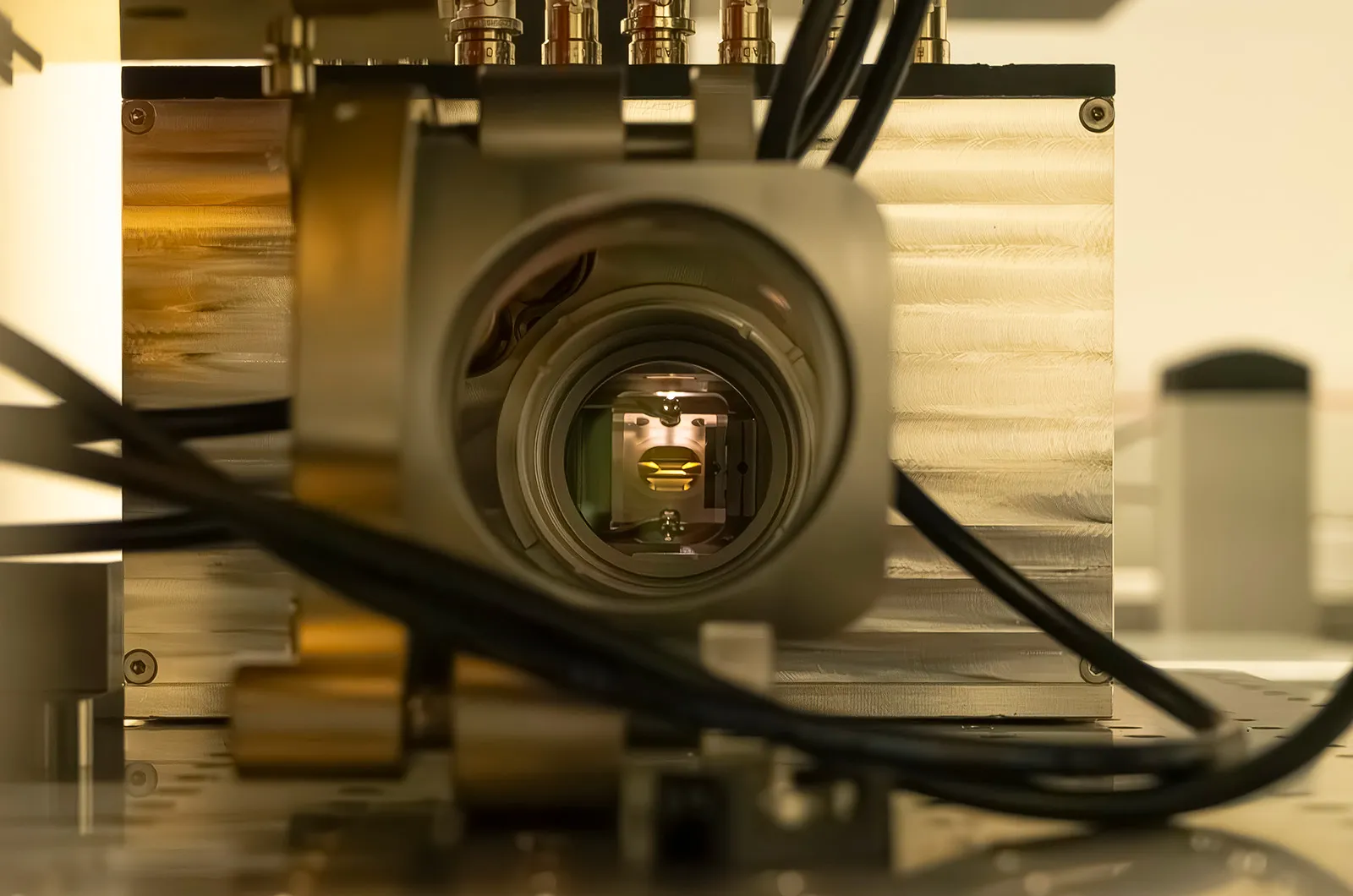
In this regard, Galicia will make its cutting-edge quantum computing and analogue simulation resources available through the IGFAE-CESGA Quantum Computing Lab, enabling researchers to develop and test quantum algorithms for hadron and nuclear physics problems. Remote access will be provided to CESGA’s quantum computer and quantum emulation resources, as well as to the analogue quantum simulator installed at IGFAE, a facility that is currently unique in Spain and which will also be the only quantum simulation infrastructure within HADRON-2030.
Through this participation, IGFAE maintains its presence in leading projects devoted to the study of the strong interaction. HADRON-2030 builds on the achievements of STRONG-2020,which was chaired by IGFAE researcher Elena G. Ferreiro, now a member of the HADRON-2030 Executive Board.
The Institute’s involvement also included Néstor Armesto, who coordinated one of the work areas devoted to deep inelastic scattering (DIS) studies at the LHC and future experiments, while Elena G. Ferreiro, together with Carlos Salgado, were members of the Steering Committee responsible for designing and drafting the proposal. In HADRON-2030, researcher Yassid Ayyad also takes on coordination duties, leading the transnational access working group for the IGFAE and CESGA quantum simulator.
The strong nuclear interaction is one of the four fundamental forces of nature. It binds quarks and gluons together to form protons, neutrons and other hadrons and, in turn, holds together the protons and neutrons in the atomic nucleus, where almost all the mass of visible matter is concentrated. The theory that governs it, quantum chromodynamics, is a fundamental part of the Standard Model of particle physics.
After decades of research, it remains very difficult to calculate the behaviour of the strong interaction under different conditions of energy and density. As a result, important questions remain unresolved regarding, among other issues, the properties of neutron stars, the interpretation of collider measurements, neutrino experiments, tests of fundamental symmetries and searches for particles or interactions beyond the Standard Model.
To explore the frontiers of this discipline, the HADRON-2030 programme will address precision physics, hadron spectroscopy, nuclear structure, strongly interacting matter under extreme conditions, nuclear astrophysics and three-dimensional studies of the internal structure of protons and other hadrons.
Fundamental research on the strong interaction enables, among other advances, the development of instrumentation and applications that reach other areas of society, such as medical imaging and treatments (including proton therapy), radiation monitoring, security technologies, industrial inspection and high-performance computing.
In addition, as part of its societal impact objectives, the project includes significant investment in schools, workshops, webinars, research stays, exchange visits and hands-on activities related to research infrastructures, providing training to PhD students, postdoctoral researchers, engineers and technical staff.
HADRON-2030 is funded by the European Union’s Horizon Europe Research and Innovation Programme under Grant Agreement No. 101292522.
News