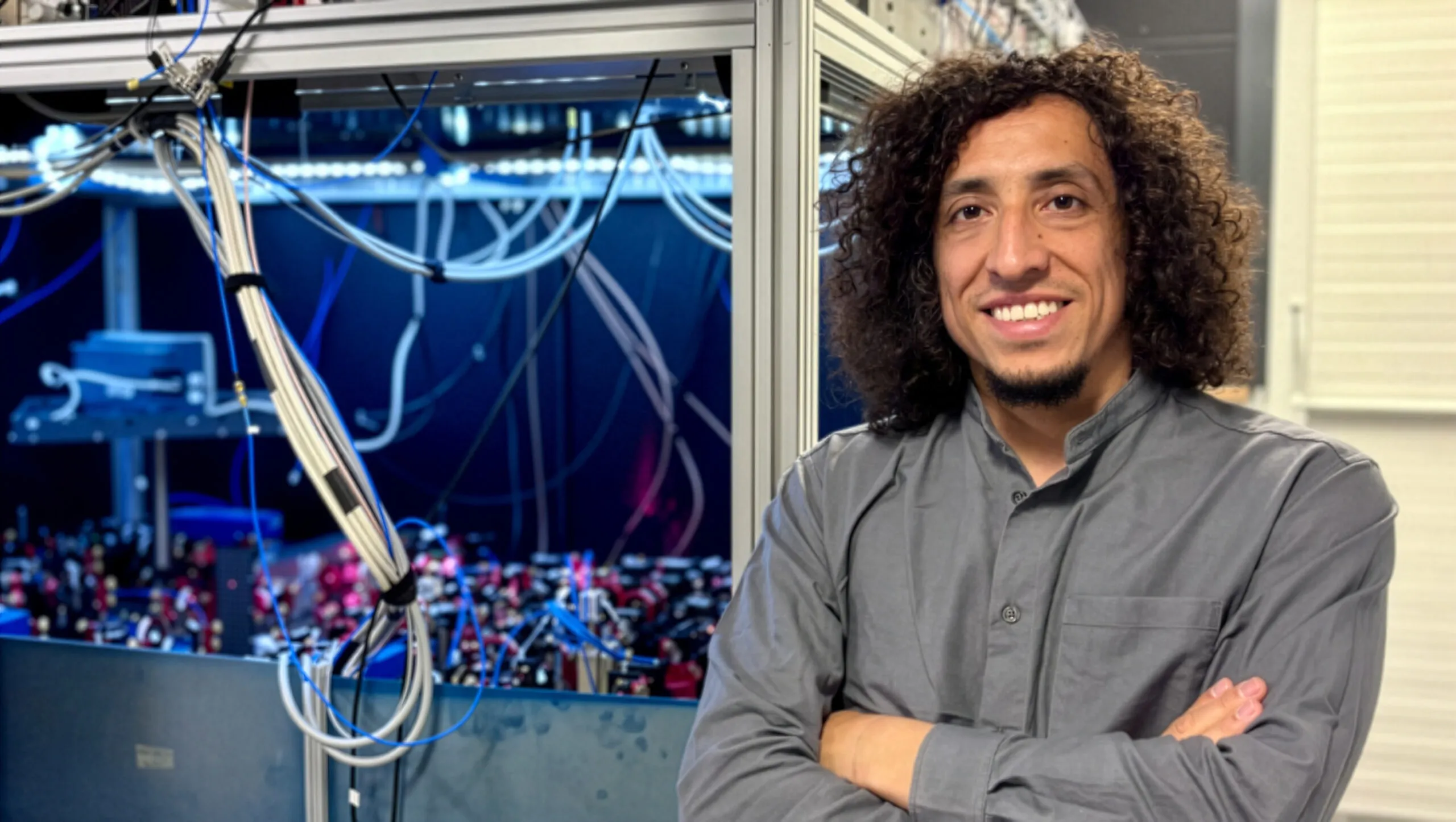
César Cabrera, a experimental physicist coming from the University of Hamburg (Germany), joins the Instituto Galego de Física de Altas Enerxías (IGFAE), a research center of the Universidade de Santiago de Compostela (USC) and the Xunta de Galicia, to develop a quantum simulation project with ultracold atoms. Dr. Cabrera obtained the prestigious Starting Grant from the European Research Council (ERC) in 2025 for a project funded with €1.9 million. The goal of his research is to build a quantum simulator to understand how many atoms interact with each other, and how those interactions can give rise to new states of matter that could inspire future quantum technologies.
A “mock-up” to understand the quantum world
Dr. Cabrera’s work focuses on trapping, manipulating, and cooling individual atoms to extremely low temperatures, close to absolute zero. “At these temperatures,” he explains, “something special happens: the effects of quantum physics, which we normally do not perceive in our everyday lives, dominate the behavior of matter.” In this way, “we can observe phenomena that seem taken from science fiction and directly explore how the quantum world works.”
The researcher gives an example: “Imagine we want to understand how a very complex material works, one that can conduct electricity without energy loss, a superconductor.” Here, quantum simulation offers advantages over direct observation: “Instead of studying that material directly, where millions of particles interact with each other in ways that are very difficult to observe, we can build a ‘quantum mock-up’ in the laboratory using ultracold atoms.” Doin so, “by cooling the atoms, we are able to place and control them with great precision, allowing us to recreate the same physical rules and observe step by step how the system behaves.”
By creating these simulators, adds Dr. Cabrera, “we can explore phenomena that are very difficult to calculate on a conventional computer, which helps us better understand how properties such as magnetism or superconductivity arise, and also discover new states of matter that we still do not know.” In the long term, he concludes, “this knowledge can inspire new quantum technologies: from more efficient materials to extremely precise sensors.”
A new line of research at IGFAE
The arrival of César Cabrera is part of IGFAE’s strategy to open a new line of research in quantum science and technology. It also represents a new challenge for the physicist himself. “My choice also has a very personal motivation. I am not only looking to develop my project in a center of excellence, but also to build something from scratch: to open a line of research in ultracold atoms and quantum simulation, and to train students and young researchers in this emerging area,” he points out.
In this sense, he mentions the commitment being made in Galicia to this discipline, with initiatives such as the Quantum Computing Lab, promoted by IGFAE itself and CESGA (Galicia Supercomputing Center). “I am excited by the idea of contributing to making Galicia a place where frontier science in quantum technologies is also carried out, and the Universidade de Santiago de Compostela offers a very rich academic environment and a community of very talented students, with whom I hope to build this project in the long term.”
In addition, the researcher highlights IGFAE’s scientific agenda as another of the reasons for choosing Galicia. “IGFAE has a very dynamic, open, and collaborative scientific environment, ideal for developing ambitious projects and creating new ideas in an international context.” César Cabrera points out that “the fact that IGFAE is not focused exclusively on quantum technologies is precisely something that I find very attractive, as it allows me to come into contact with areas of physics different from my previous experience and learn new concepts, think differently, ‘outside the box’, combine ideas from different fields and, ultimately, try to do something truly new that pushes science forward.”
Biography of César Cabrera
César Cabrera Córdova is an experimental physicist specialized in the study of ultracold quantum gases and quantum simulation. His research focuses on trapping, cooling, and manipulating individual atoms to study complex phenomena of quantum physics in highly controlled systems. In this way, these systems are used as quantum simulators to recreate and understand how new properties of matter emerge when many particles interact with each other.
Dr. Cabrera studied Physics at the Autonomous University of San Luis Potosí (Mexico) and then completed a master’s degree at the University of Bonn (Germany). He developed his doctoral thesis at ICFO (Institute of Photonic Sciences) in Barcelona, where he participated in pioneering experiments with ultracold quantum gases, including the first observation of a Bose–Einstein condensate in Spain.
Later, he joined as a postdoctoral researcher at the Max Planck Institute of Quantum Optics in Munich and at the Institute of Quantum Physics in Hamburg, where his work focused on the study of strongly correlated quantum systems and on the development of microscopy techniques to observe and manipulate individual atoms.