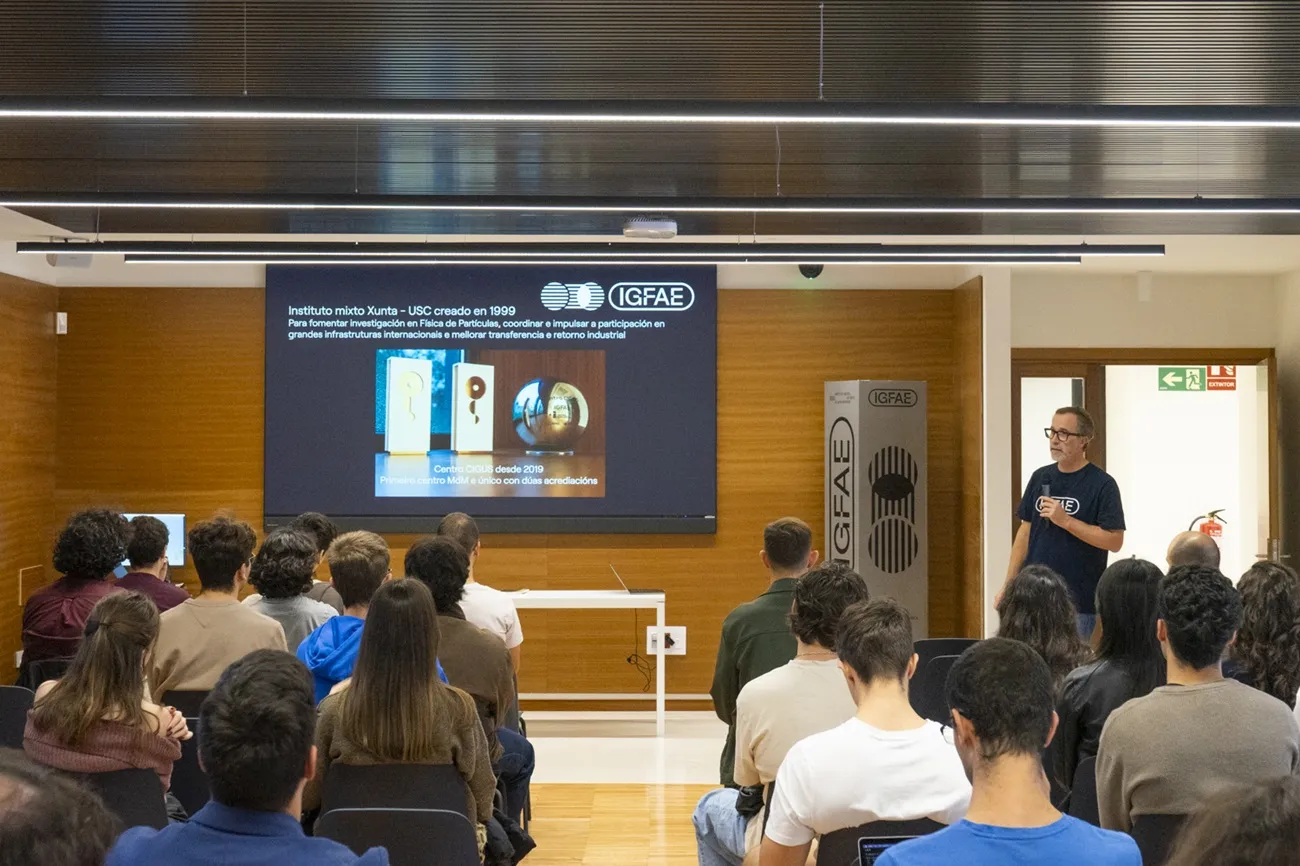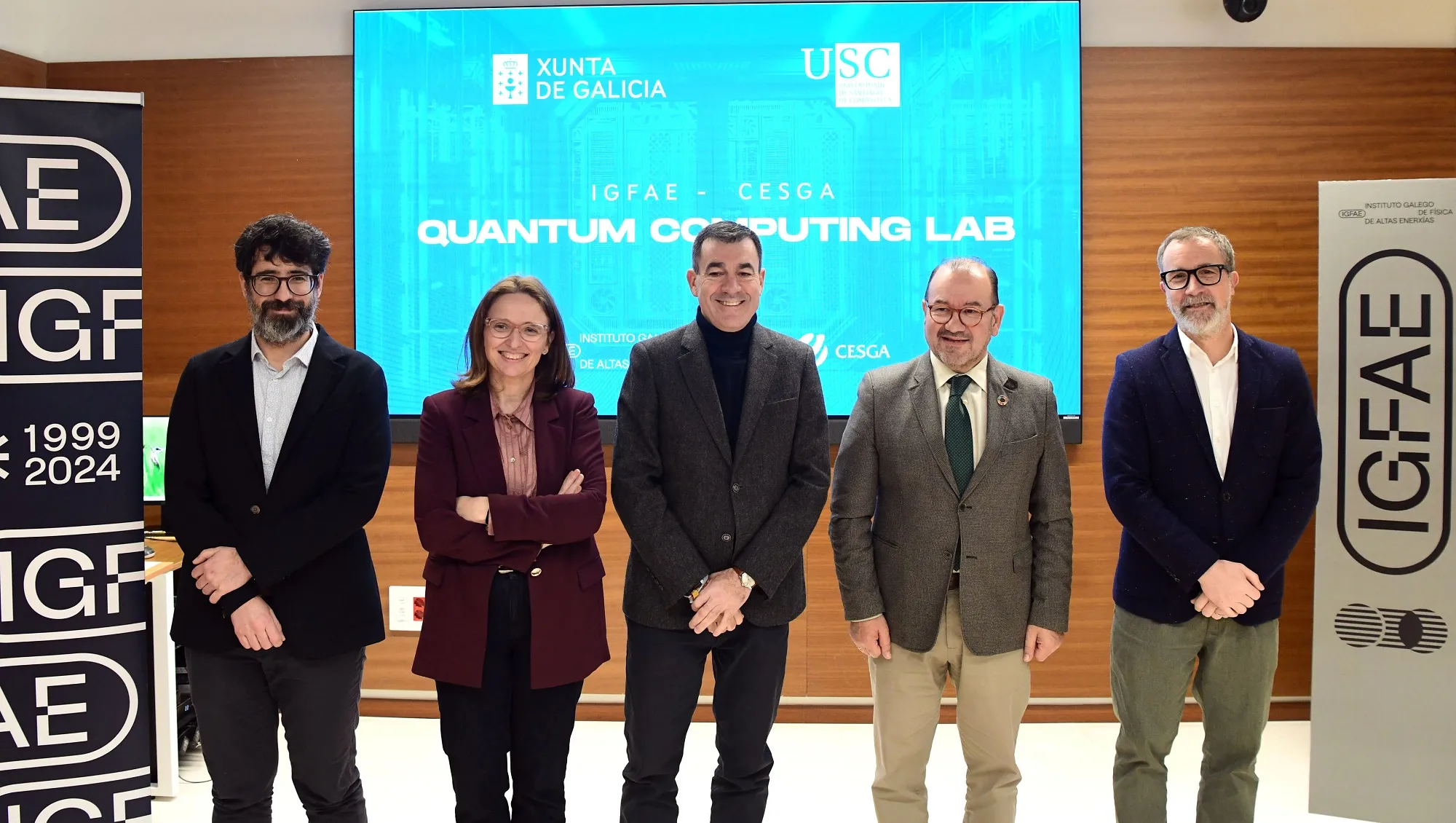
The headquarters of the Instituto Galego de Física de Altas Enerxías (IGFAE) hosted this Wednesday, January 14th, the signing of the agreement for the creation of the IGFAE-CESGA Quantum Computing Lab, a new joint research unit in quantum technologies applied to particle and nuclear physics.
Through this agreement, IGFAE and the Galician Supercomputing Center (CESGA) strengthen, as reference centers in their respective fields of work, their strategic alliance in the research and development of quantum computing and reinforce Galicia’s commitment to this discipline and its applications in various areas of physics. The project has an investment of 2.2 million euros, co-financed by PERTE Chip and funds from the Xunta de Galicia’s Department of Education, Science, University and Vocational Training, as well as funding from IGFAE itself.
The agreement was signed, on behalf of the parties, by Antonio López Díaz, rector of University of Santiago de Compostela, and Román Rodríguez González, regional minister of Education, Science, Universities and Vocational Training of the Xunta de Galicia. Also participating in the event were Carmen Cotelo Queijo, director of the Galician Innovation Agency (GAIN); the director of IGFAE, Carlos A. Salgado López; and the scientific director of CESGA, Lois Orosa Nogueira.
A unique quantum simulator in Spain
The Quantum Computing Lab, which will be located at the IGFAE headquarters in USC’s South Campus (Santiago de Compostela), will combine IGFAE’s theoretical, experimental, and instrumentation capabilities with CESGA’s computing infrastructure. It will focus on the quantum simulation of processes of great interest in particle and nuclear physics, using technologies such as ion traps or cold atoms.
This is a facility that can function both as a simulator and as a computer, allowing the manipulation of a quantum system analogous to the one being studied. It will be, at this moment, the only one in Spain with these characteristics in the field of nuclear and particle physics. This initiative is also part of a European project that will enable its use as a remote-access laboratory.
Fundamental research for future social applications
Particle and nuclear physics have traditionally been an excellent testing ground for the development of emerging technologies that end up having a profound social impact (medical imaging, sensors, the World Wide Web, distributed computing, artificial intelligence algorithms, etc.).
The processes that occur inside the atomic nucleus or at even smaller scales, typical of particle physics, are dominated by quantum effects that traditional computing generally cannot reproduce. Quantum computers, however, naturally implement quantum coherence or entanglement. The new IGFAE-CESGA laboratory will enable the creation of innovative simulations to study these physical phenomena, opening the door to advances that will soon be applied in other scientific and technological fields.
Among other opportunities, quantum technologies make it possible to carry out simulations to better understand the structure of the atomic nucleus, especially in exotic cases where quantum coherence phenomena (the superposition of two or more states) manifest.
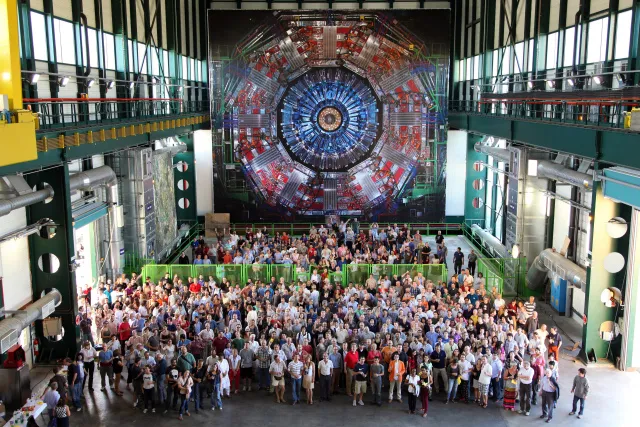
In addition, these systems help study with much greater precision the quark–gluon plasma, a primordial state of matter generated a few millionths of a second after the Big Bang, and which is recreated today, through particle collisions, in accelerators such as CERN’s Large Hadron Collider (LHC).
Furthermore, the Quantum Computing Lab will also deepen the analysis of the influence of external disturbances, such as cosmic radiation, on the functioning of quantum devices.
Commitment to new infrastructure and personnel
This new joint research unit will have, at IGFAE facilities, a 60 m² space for a quantum information and Quantum Cosmics laboratory, reinforced by the capabilities of other IGFAE infrastructures such as a clean room (110 m²), microelectronics laboratories, gaseous or scintillator detectors, and micromachining, metrology, or irradiation rooms.
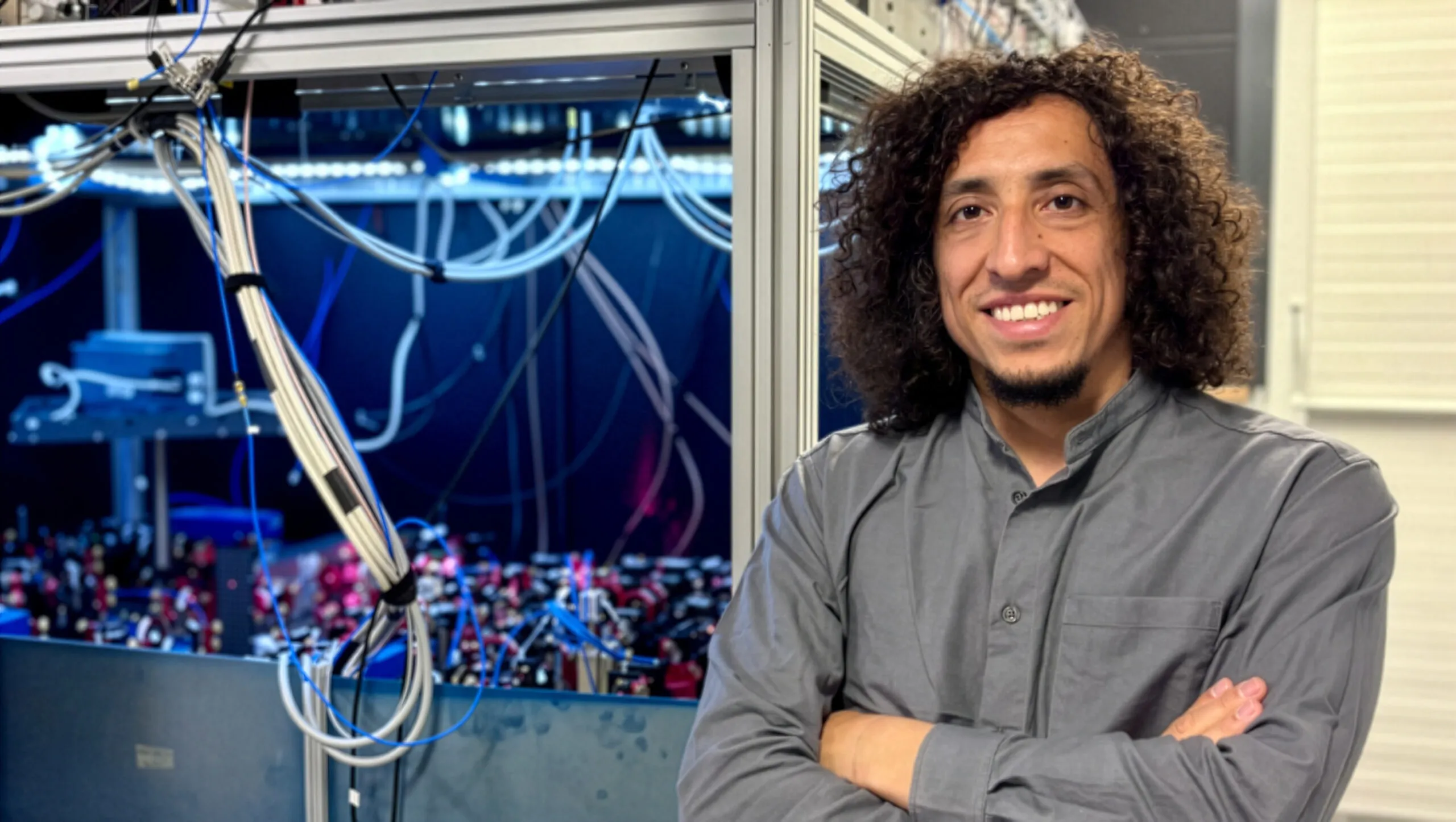
The project also includes funding for scientific and technical personnel, both through existing contracts and new hires, to support the development of the planned lines of work. The IGFAE team involved in the launch of the Quantum Computing Lab is made up of Yassid Ayyad, Cristina Cabo, Héctor Álvarez, Wenyang Qian, David González, and Carolina Filgueira. They will soon be joined by internationally renowned scientists in the field of quantum science and technologies, as well as early-stage researchers.